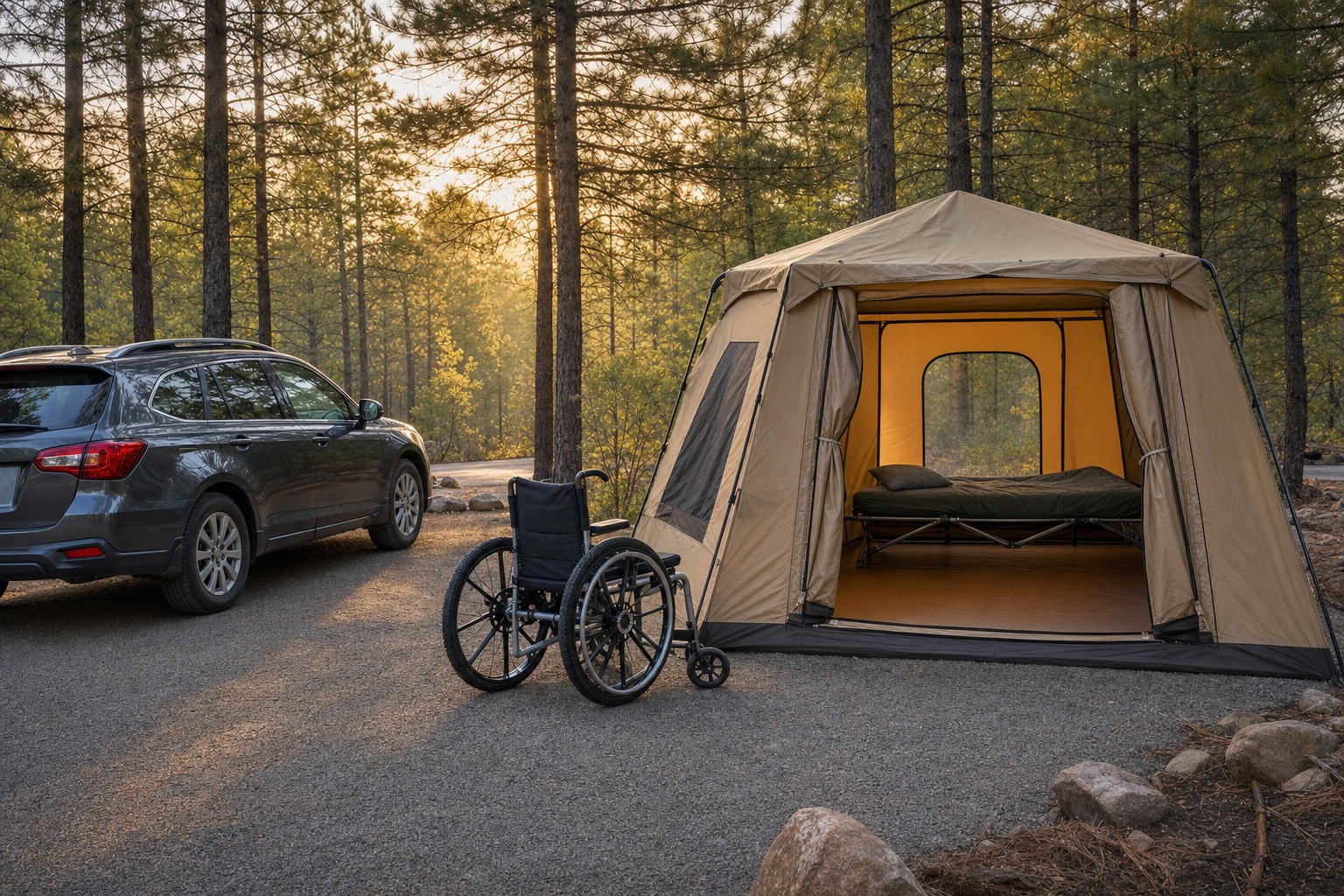
You don't need a special kit off someone else's packing list. The best adaptive camping gear for beginners is a handful of pieces matched to your specific limitation: and a lot of what removes barriers isn't specialized equipment at all. For a first trip, the dependable path is to car-camp at a verified accessible site and solve the three things that stop most people cold: putting up the tent, getting from the ground to a bed, and cooking. Rent or borrow what you can, test everything in your backyard first, and bring a companion until you know your setup holds.
That advice holds for car camping at developed campgrounds in mild three-season weather. Backpacking, backcountry, and winter camping change the answers completely (different insulation, different loads, different risk) so treat this as a car-camping playbook, not a lightweight one.
What counts as adaptive camping gear
Adaptive camping gear is any equipment chosen or modified to lower a barrier created by limited mobility, strength, dexterity, vision, hearing, sensory needs, or chronic illness. "Adaptive" usually means the right mainstream feature (a push-button igniter, a wide door, a firm high seat) or a cheap tweak (a paracord loop on a zipper), not a costly specialty product. Buy for your actual need, and most of your budget stays in your pocket.
Start here, before you spend a dollar
The highest-value moves cost little or nothing, and they matter more than any single purchase. Do these in order:
- Book a drive-up, hard-surface accessible site. Car camping means level, hardened pads, concrete or compacted gravel, close to parking, so you carry heavier, comfier gear a short distance instead of hauling a light pack far.
- Rent or borrow before you buy. Door layouts, cot heights, and chair seats vary enough that you want to learn what fits your body before you own it.
- Do a backyard test night. Set up the tent, practice the transfer onto the cot, and cook one meal at home. The failures you find on your own lawn are free.
- Bring a companion for the first few trips. Solo comes later, once your setup is proven.
Match your need to your gear
There is no universal adaptive kit, so start from your own limitation and pull only the pieces that address it. This table is the shortcut: find your row, then read the matching gear section below for the numbers.
| Your need | Gear or features that help |
|---|---|
| Wheelchair use | Wide low-threshold tent (~36 in door), large vestibule, cot at transfer height, portable ramp, ground mat, roll-under table |
| Limited hand strength or dexterity | Loop or oversized zipper pulls, push-button stove ignition, magnetic/Velcro closures, built-up utensil handles, universal cuff |
| Low energy, chronic fatigue, or chronic illness | Instant/hub tent, self-inflating pad, rolling cooler, site close to parking, pre-made meals, backup power plan |
| Balance difficulty | Firm high cot, chair with armrests, nonslip mat, trekking poles with quad-cane tips, illuminated guy lines |
| Low vision | High-contrast cordage, tactile stove markers, glow or bright zipper pulls, phone navigation with audio cues |
| Deaf or hard of hearing | Vibrating weather alarm, visual door/motion alarm, text-capable emergency device, two-way radios with large buttons |
| Sensory sensitivity | Blackout tent liner, noise-canceling headphones, dimmable warm light, familiar bedding, tagless clothing |
Tents: easy to put up is not the same as easy to get into
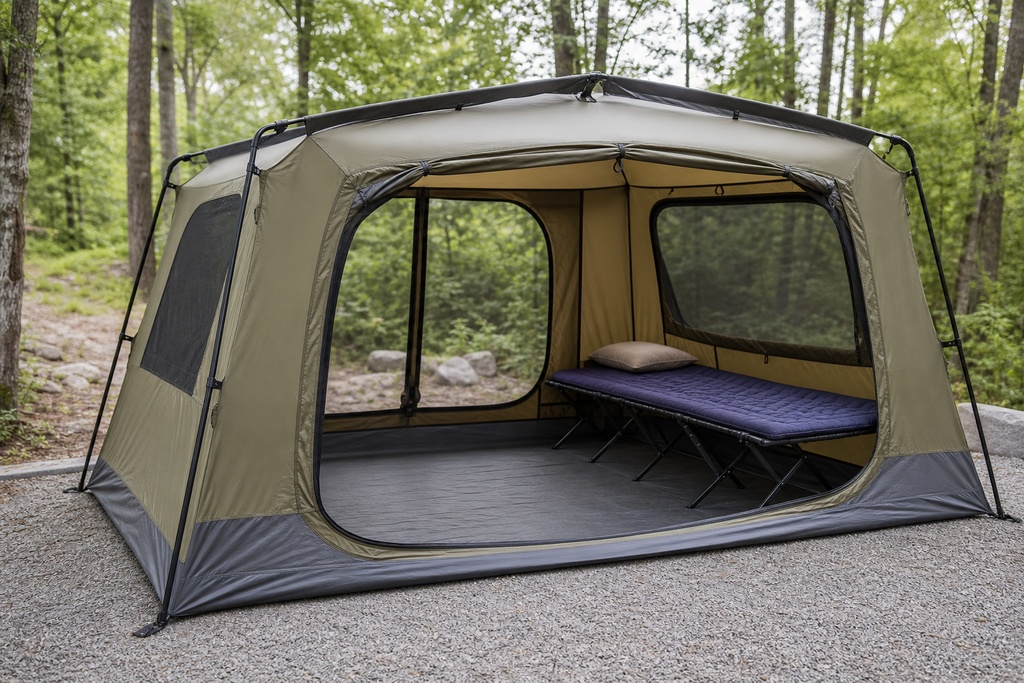
Two separate things make a tent work, and beginners blur them: how hard it is to pitch, and how hard it is to enter. Solve both. For setup, an instant or pop-up cabin tent, the Coleman Instant Cabin or Core Instant are common examples, rises in a minute or two on pre-attached poles, with no threading and no heavy lifting overhead. For entry, look for a wide, low- or no-threshold door around 36 inches, near-vertical cabin walls with a center height of about 6.5 to 7 feet so you can sit up or maneuver a chair, a large vestibule to keep a wheelchair or medical equipment dry, and oversized zipper pulls.
Size up on purpose. A 4- to 6-person tent gives one or two adaptive campers room for a wheelchair to turn and a cot to sit beside with transfer space. REI's adaptive camping guide makes the same case: more floor area, generous headroom, a substantial vestibule, and a shallow door lip. Purpose-built options like The North Face Universal Wawona 3 and the Freely tent bake these features in. Expect to spend roughly $200 to $700, which is one more reason to rent first.
Sleep setup: off the ground, and warm
A cot solves the ground transfer; it does nothing for cold. That distinction sends more first-timers home shivering than any other. The cot lifts you to transfer height, but bare fabric lets cold air rob heat from underneath, even in July, so you always add an insulated pad on top.
| Piece | What to look for |
|---|---|
| Camp cot | About bed/transfer height: roughly 15 to 24 inches depending on model, so match it to your own wheelchair or bed rather than a fixed number; removable side rails for lateral sliding; a firm edge that won't collapse; weight rating with real margin |
| Self-inflating pad | 2 to 3 inches thick; R-value 3–4 for mild nights, 5+ for cold ground; expands on its own with no blowing |
| Quilt or rectangular double-zip bag | Opens flat like a blanket; room for braces and orthotics; two-way zips ease night toileting, spasms, and temperature control |
If your circulation or temperature regulation runs cold, rate the bag or quilt below the forecast low: the number on the tag assumes an average sleeper.
Chairs and tables
Skip the low sling chair; it traps anyone who struggles to stand. Choose a firm seat 17 to 19 inches high with sturdy, weight-bearing armrests to push against for sit-to-stand, a high back, minimal seat sag, and wide feet that won't sink into gravel. Measure that seat height against the chair you use at home before buying.
For eating and cooking from a wheelchair, a standard folding table is usually too low and cross-braced. Look for a roll-under design with about 27 inches of vertical clearance under the top and 30 inches of open width, so the chair pulls straight up to the surface.
Getting around camp: wheels, ramps, and steady footing
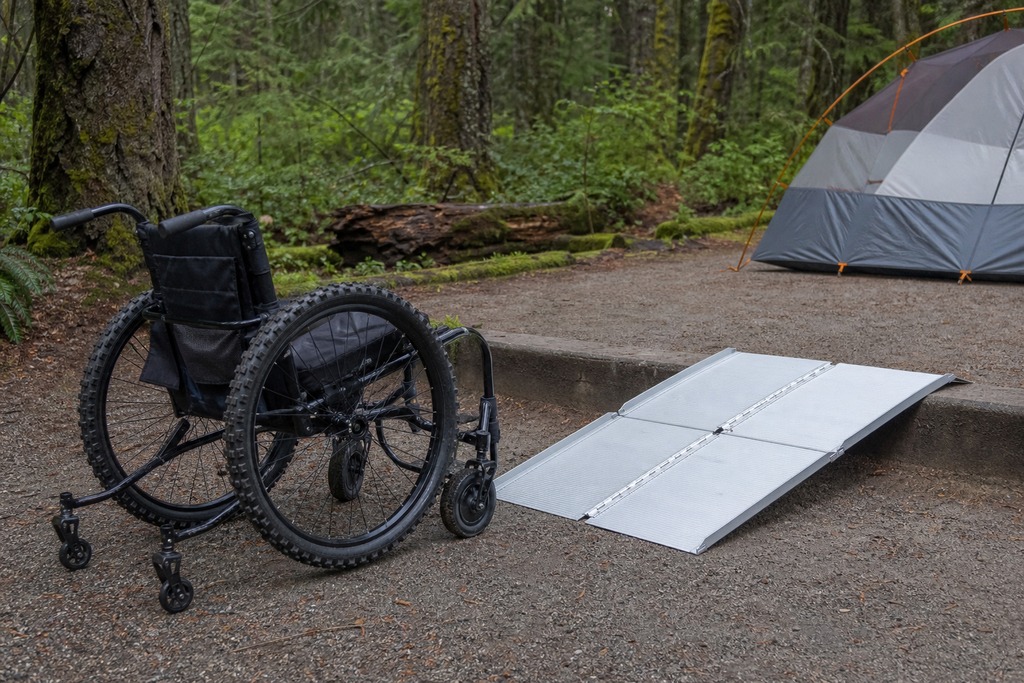
Standard casters sink in grass, gravel, and dirt: which is exactly the ground a campsite is made of. The fix is terrain-matched wheels or steadier footing, and here the specs are the whole point.
| Item | Key numbers | Why it helps |
|---|---|---|
| All-terrain manual chair (GRIT Freedom Chair, Trekinetic, Mountain Trike, Outrider) | Rear drive wheels 26–29 in; clears obstacles up to ~6 in | Rolls over roots and gravel where standard casters stall |
| Powered track chair (Action Trackchair) | Tracked drive | Crosses grass, sand, and mud under power, not muscle |
| Front-mount handcycle (FreeWheel) | Lifts the front casters off the ground | Turns a standard manual chair into a trail-capable one |
| Portable folding ramp | 10–15 lb; supports up to 600 lb; 24–36 in long | Bridges curbs, thresholds, and tent-pad lips |
| Trekking poles with quad-cane tips | ~25% less knee impact; four-pronged bases | Stability on loose dirt for balance or joint pain |
| Transfer board / ground mat | : | Slides seated transfers; firms up rolling over soft grass |
The GRIT Freedom Chair earns its place on rough drive-up sites specifically because its large rear wheels and lever drive climb small obstacles a hospital chair can't touch.
Camp kitchen: cooking with less grip and reach
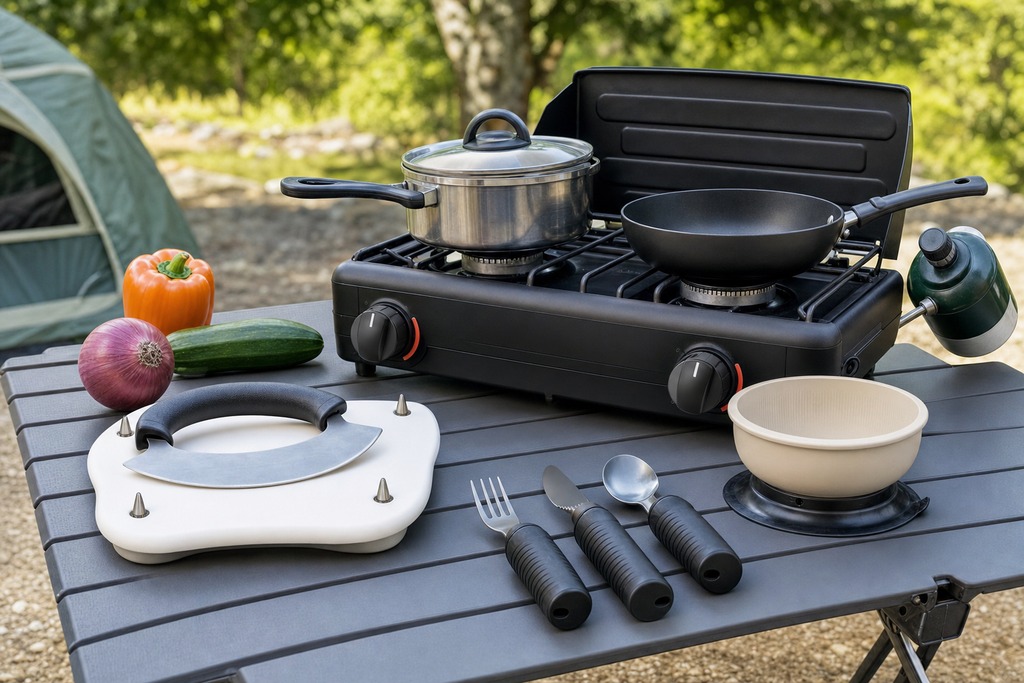
A camp kitchen becomes manageable the moment you take grip and reach out of the equation. Start with a tabletop propane stove that lights on a push-button piezo igniter (no matches, no priming) with large control knobs you can turn with a closed fist, plus tactile or color-coded markers if you have low vision. Rocker knives cut with a single downward rock instead of a sawing motion, and a one-handed cutting board with corner spikes holds food steady while you do it.
For utensils, built-up handles 1.25 to 1.5 inches in diameter demand far less grip, and a universal cuff straps a fork or spoon to a hand that can't hold one. Suction-base bowls lock to the table so unsteady hands or an uneven pad don't send dinner into the dirt. Keep a rolling cooler instead of a lift-and-carry one, and lean on pre-made or dehydrated just-add-water meals when fatigue is the limiting factor.
Sensory and comfort aids
Wind, wildlife, other campers, and a sunrise that arrives at 5 a.m. can overwhelm before the day starts. A few items make the outdoors regulate instead of assault.
| Item | What it does |
|---|---|
| Noise-canceling headphones or earplugs | Dampen sudden noise at an NRR of ~25–30 dB; transparency mode keeps safety cues audible |
| Weighted blanket | Deep-pressure input at 10–12% of body weight (a 15 lb blanket for a 150 lb person); choose one rated for outdoor temps |
| Blackout tent liner or sleep mask | Cuts incoming light up to 95%, mimicking a dark bedroom |
| Dimmable warm lantern | Replaces harsh LED glare with adjustable, low-stimulation light |
Lighting and staying in touch
Carry at least two independent light sources: a headlamp with one large button or voice control, plus a lantern you can switch on without fumbling. Then adapt for your senses:
- Big-button or voice-activated headlamp, and a remote or large-switch lantern
- A motion-activated tent light so you're not hunting for a switch at 2 a.m.
- Glow-in-the-dark or bright paracord loops swapped onto tent and bag zipper pulls
- For hearing needs: a vibrating weather alarm, visual door/motion alarm, and two-way radios with large buttons
- For vision needs: phone or GPS navigation with audio cues, high-contrast cordage, and downloaded maps: campground reception is unreliable, so pull them before you arrive
Clothing and footwear
Getting dressed at camp trips up more people than the tent does. Step-in hands-free shoes like Kizik or Skechers Slip-ins have collapsing heels you slide into without bending down or using your hands. Magnetic buttons and large Velcro fasteners replace the small buttons and zippers that defeat limited dexterity. And for sensory sensitivity, seamless, tagless apparel with flatlock seams removes the scratch-and-rub that makes a whole night miserable.
Power and medical devices: read this one twice
If a device keeps you well, plan its power like your trip depends on it, because it does. Match a portable power station's capacity in watt-hours to what your equipment actually draws overnight (a CPAP, say) and size up from there; Jackery, EcoFlow, and Bluetti all publish device runtime estimates. Never treat a campground outlet as guaranteed. Confirm the hookup exists and stays live, and still bring your own battery and a written backup plan for anything critical. A wheeled cooler with a telescoping handle keeps insulin and medication cold without heavy lifting. One rule has no exceptions: never run a stove, grill, or fuel-burning heater inside a tent: the fire and carbon-monoxide risk is real and it kills people every year.
🏕️ Essential Adaptive Camping Gear
The limitation-matched pieces earlier get the attention, but a short list of universal essentials belongs in every load, and each one matters more when standing, walking, or reaching is what drains you. Pack these alongside your adaptive gear:
- A first-aid kit and a few extra days of any medication you take. A weather delay or a longer drive home shouldn't leave you short.
- Refillable water containers you can keep beside your seat. Hydration slips when every refill means a trip across camp, so store water where you actually sit.
- Sun and insect protection — broad-brim hat, sunscreen, repellent — because you may be parked in one exposed spot for hours rather than moving in and out of shade.
- A small repair kit: duct tape, spare cordage, and a multi-tool. A jammed zipper or a tweaked pole can strand a setup you can't wrestle back by hand.
- Wipes, hand sanitizer, and trash bags for tidy cleanup that doesn't hinge on a long walk to water.
Cheaper ways to adapt what you already own
A large share of "adaptive" gear is a two-dollar modification. Before you buy specialty equipment, try these:
- Paracord loops added to tent, bag, and jacket zipper pulls for grip
- Foam pipe insulation slid over thin utensil, pole, and pot handles to build them up
- Used gear from REI Used Gear, online marketplaces, and disability gear exchanges
- Free loans from park and nonprofit lending libraries, which stock cots, chairs, and sometimes all-terrain wheelchairs
Finding a genuinely accessible site: and where to get help
An "ADA-accessible" label is a starting point, not a promise. Verify the actual surface, door threshold, transfer space, and restroom access before you book: the National Park Service and REI both stress checking the real site rather than trusting the tag. These resources do the legwork.
| Resource | What it gives you |
|---|---|
| Recreation.gov accessibility filter | Screens federal campsites by accessibility features |
| AllTrails accessibility reviews | Trail and access notes from other users |
| Wheelmap.org | Crowd-mapped wheelchair-accessible locations worldwide |
| America the Beautiful Access Pass | Free lifetime pass for U.S. citizens/residents with a permanent disability; covers federal entrance fees |
| NPS Accessibility pages | Official site details, not just labels |
| Disabled Hikers | Detailed accessibility trail guides and community knowledge |
| Programs (Wilderness Inquiry, Adaptive Outdoor Education Center, High Fives Foundation) | Guided, equipment-included adaptive trips |
| Gear makers (GRIT, Freely, Enabling Devices) | Purpose-built adaptive tents, chairs, and accessories |
Who should NOT camp solo yet
Go with a companion or a guided program, not solo, if your needs are high-acuity or you can't yet finish a backyard test night. If a device failure would be a medical emergency, an unverified campground is the wrong place to discover it; a program like Wilderness Inquiry or the Adaptive Outdoor Education Center supplies both the equipment and the backup. Two more honest "no"s: don't buy a generic adaptive kit off someone else's list, because you'll pay for gear you never use, and don't apply this guide to backpacking or backcountry travel, where lightweight optimization works directly against the comfort and capacity that make car camping accessible.
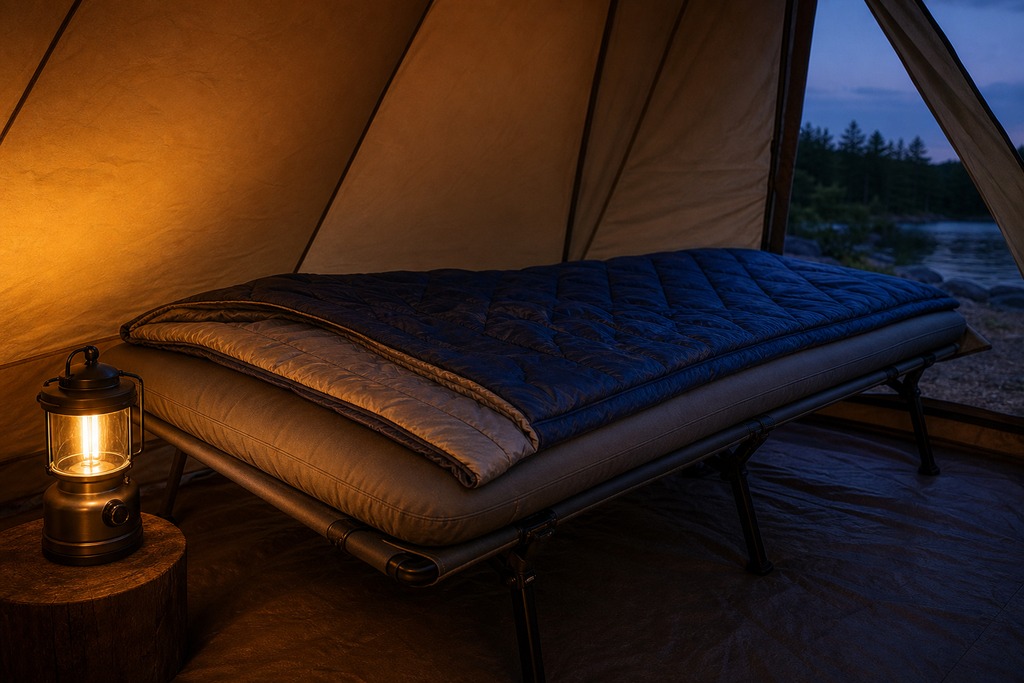
Your first-trip starter kit
Here's the combination that covers all three barriers (setup effort, ground transfers, and cooking) for a first weekend at a developed accessible site:
- Instant or pop-up cabin tent with a wide, low-threshold door
- Sturdy elevated cot at your transfer height
- Self-inflating pad, R-value 3–4, on top of the cot
- Rectangular two-way-zip sleeping bag or quilt
- Push-button propane stove with large knobs
- High-seat camp chair, 17–19 inches, with armrests
- Portable power station: only if you depend on a medical device
Buy or borrow those, prove them on your lawn, and your first real night out is mostly a matter of showing up.
📋 Beginner Tips for Adaptive Camping
- Arrive with daylight to spare. Pitching the tent and rehearsing that first transfer is far easier before dark, so time your drive to reach the site mid-afternoon, not at dusk.
- Try a single overnight before you commit to a full weekend. One night shows you what your system gets right and where it fails, and you extend from there.
- Leave your plan with someone off-site. Tell a person where you're camping and when you expect to be back, which matters most where cell coverage is thin.
- Bring layers you can add or shed without help. The temperature swings between a warm afternoon and a cold night, and managing it yourself keeps one rough patch from sinking the trip.
- Scout the restroom route as you arrive. Note the distance and the surface between your site and the toilet while it's still light enough to see them.
Quick Tips for Beginner Adaptive Campers
A scannable list for the day itself:
- Set up your sleep and transfer area first, before the kitchen or the fire.
- Point the tent door toward your car and the flattest ground for the shortest transfer path.
- Pace the work: rest between tasks instead of pushing through the whole setup in one go.
- Give the tent one last zipper-and-pole check before dark, while fixes are still easy.
- Keep the paths you use most clear of guy lines and cords a wheel or foot could snag.
FAQ
What camping gear is good for beginners?
For an adaptive beginner, the seven-piece starter kit above covers the three real barriers: an instant cabin tent, an elevated cot, an insulated pad, a rectangular or quilt-style bag, a push-button stove, a high-seat chair, and a power station if you use medical equipment. Start from the need table earlier in this guide, not a one-size list: the right gear is set by your specific limitation.
What is the 200 rule for camping?
The 200 rule is a Leave No Trace guideline: pitch camp, wash, and dispose of human waste at least 200 feet, roughly 70 big steps, from lakes, streams, and trails to protect water sources. It applies to everyone, adaptive or not, but matters most in dispersed backcountry camping. At a developed accessible campground you'll typically use provided pads and restrooms, so it rarely comes into play.
What is the 333 rule for camping?
The 3-3-3 rule is a general road-trip and RV planning habit, not an adaptive-gear concept: a widely cited version is to drive no more than about 300 miles a day, stop by 3 p.m., and stay at least 3 nights before moving on. Variants differ, so treat it as a rule of thumb. It's genuinely useful if long drives tax your energy, but it's outside the scope of choosing gear.
What are the 7 C's of camping?
The 7 C's are a bushcraft memory aid for backcountry survival essentials: commonly cutting tool, combustion, cover, container, and cordage, plus two more that vary by list (often a light source and cargo tape or a compass). It's a general wilderness-preparedness convention, not part of adaptive gear selection, and largely unnecessary for car camping at a developed site where you simply drive your comforts in.
References
- REI, Guide to Adaptive Camping — https://www.rei.com/learn/expert-advice/guide-to-adaptive-camping.html
- REI, Sleeping Pads: How to Choose (R-value) — https://www.rei.com/learn/expert-advice/sleeping-pads.html
- The North Face, Universal Collection — https://www.thenorthface.com/en-us/collections/universal-collection
- National Park Service, Accessibility — https://www.nps.gov/subjects/accessibility/index.htm
- Recreation.gov (campsite accessibility filter) — https://www.recreation.gov
- America the Beautiful Access Pass — https://store.usgs.gov/access-pass
- AllTrails (accessibility features) — https://www.alltrails.com
- Wheelmap.org — https://wheelmap.org
- Disabled Hikers — https://disabledhikers.com