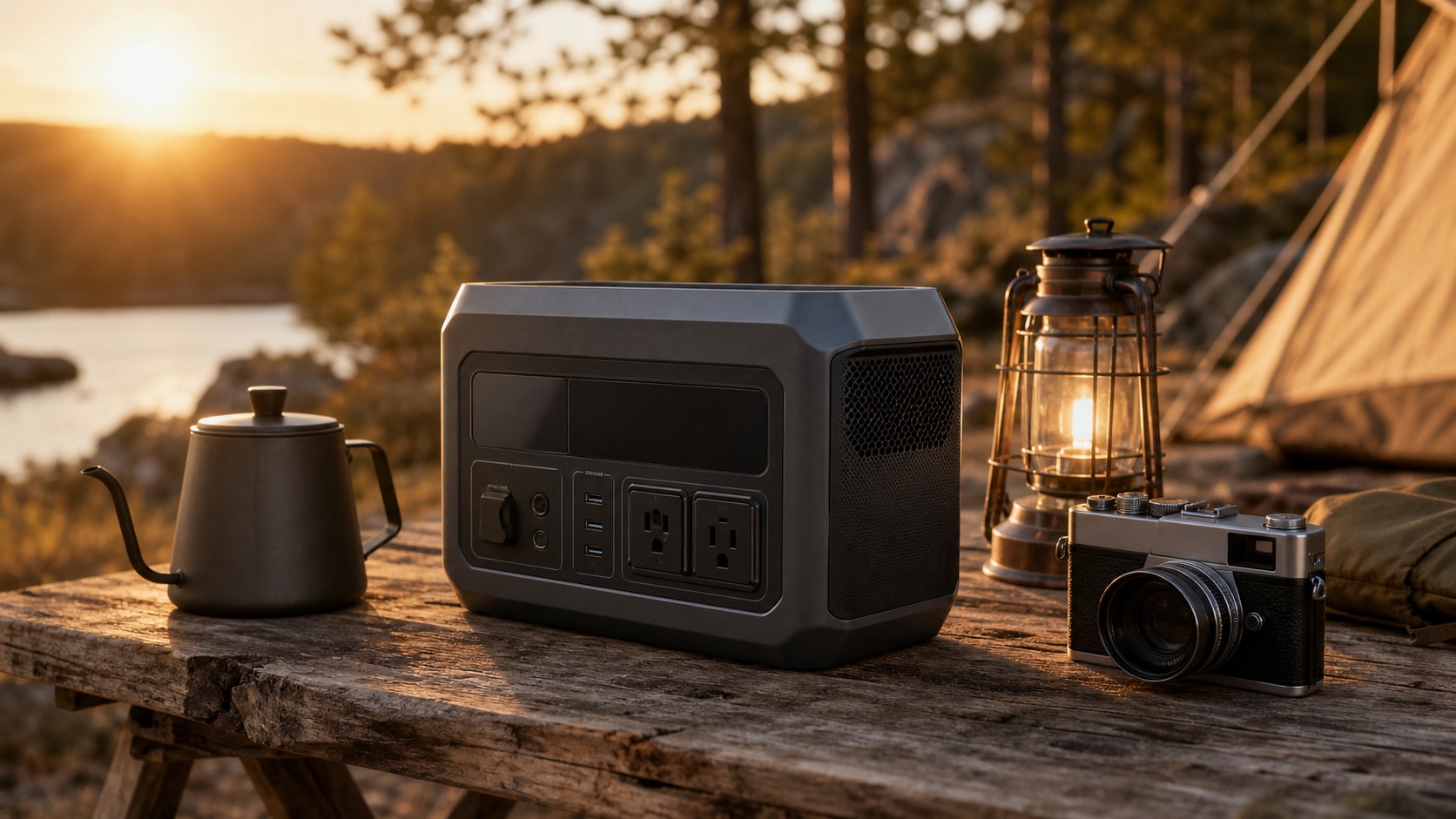
The right portable power station for camping isn't the biggest one: it's the one matched to your trip and your hungriest device. For most car campers, a 500–1,000Wh LiFePO4 unit ($400–$700) hits the sweet spot for capacity, weight, and price. Size it by two separate numbers: total energy in watt-hours (Wh), which sets how long it lasts, and continuous output in watts (W), which decides what it can run at all. A giant battery with weak output still won't boil a kettle. Nail those two numbers and the model almost picks itself.
Kill one myth before you shop: a bigger battery does not mean it can power anything. That's the mistake that leaves people staring at a dark coffee maker next to a 2,000Wh unit. Capacity and output are different specs, and the second one is the one buyers ignore.
What a portable power station is (and why not gas)
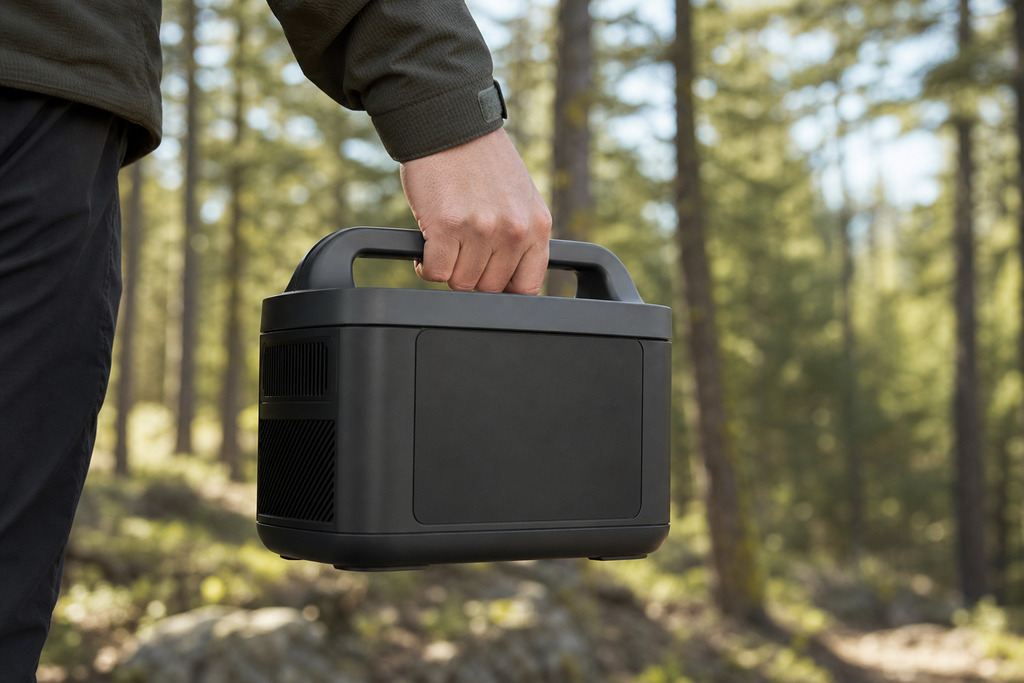
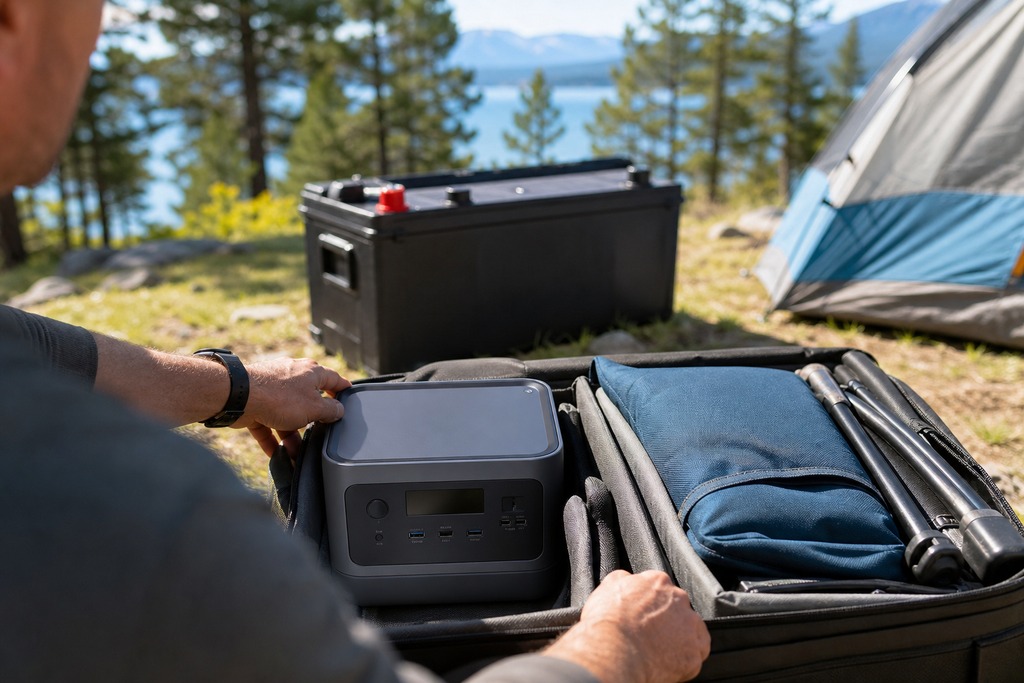
A portable power station is a rechargeable battery generator with AC outlets, USB ports, and a 12V DC socket, built to carry from your vehicle to your campsite. It replaces a gas inverter generator without the fumes, the noise, or the upkeep. There's no oil to change, no pull-start, no spark plugs, and no exhaust: which is why you can safely run one inside a tent, van, or RV where a gas generator would be dangerous and against most campground rules. The trade-off is total energy: gas gives you effectively unlimited runtime with a fuel can, while a battery holds a fixed charge you refill from the wall, your car, or the sun. For weekend camping without an engine droning at 6 a.m., that trade is easy.
This is also not a phone-charging power bank, not a fixed home backup system, and not a bare solar panel. It's the middle category: enough juice to run appliances, small enough to lift into the trunk.
The two numbers that actually decide your purchase
Two specs matter more than anything else on the box: capacity (Wh) and continuous output (W). Capacity is your fuel tank: a 500Wh station runs a 50W device for roughly 10 hours. Output is the size of the tap: it caps how much power flows out at any instant. A 300W unit physically cannot run an 800W coffee maker no matter how full the battery is, because the appliance's steady draw has to sit under the station's continuous rating.
There's a third number to watch on anything with a motor: surge output. A 12V fridge or compressor spikes hard for a fraction of a second when it kicks on, pulling far more than its running wattage. Stations list a surge figure (often double the continuous rating) to handle that startup jolt. Match your fridge's running watts to continuous output, and let surge cover the kickstart. Get output right first, then worry about how many watt-hours you need.
How much capacity you need, by trip type
Size capacity to how long you're out and what you plug in. These three tiers cover nearly every camper.
| Camping style | Recommended capacity | Typical devices it powers |
|---|---|---|
| Day trips / tent camping | 200–500Wh | Phones, LED lights, action cameras, drones, a small fan |
| Weekend car camping | 500–1,000Wh | Laptops, a CPAP, a 12V fridge, camera gear, fans, lights |
| Extended off-grid / van / RV | 1,000–2,000Wh+ | Multiple appliances, coffee makers, microwaves, sustained fridge use |
If you only charge phones and run lights, buying into the top tier means hauling 50–70 lbs for capacity you'll never touch. Bigger isn't automatically better: it's more weight, more money, and no benefit unless a real appliance justifies it.
What Can a Portable Power Station Run?
Camping gear splits cleanly into two groups, and the divide is output, not battery size. On one side sit low-draw electronics and lighting — the things any modest unit handles without strain. On the other sit heating appliances, which pull hundreds of watts continuously and simply refuse to start under a small output rating.
The comfortable, low-draw side is broader than most people expect. Beyond phones, laptops, fans, and camp lights, it covers tablets and e-readers, drones and their controllers, Bluetooth speakers, string lights, a portable projector or small TV for a movie night, a Starlink dish, and the chargers for cameras and e-bikes. These plug in and run for a long time on even an entry-tier station.
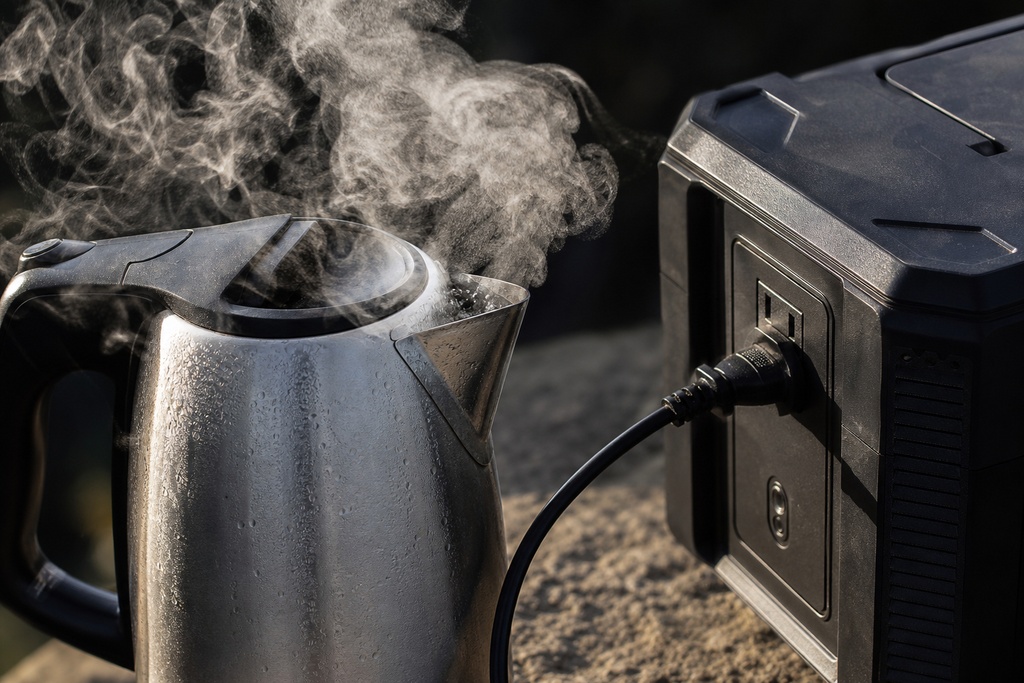
The high-draw side is defined by heat. Anything that makes heat with a resistive element — an electric kettle, coffee maker, microwave, toaster, hair dryer, induction burner, portable electric grill, or space heater — demands 1,000W or more of continuous output before it will run at all. This is the exact line that separates a station you can cook on from one that only keeps your devices alive. If cooking or boiling water is on your list, check the continuous output rating first; capacity has nothing to do with whether these appliances turn on.
What your gear actually draws (and how long it runs)
Here's what common camping gear pulls and how long a 500Wh station holds out. Real runtime always falls a bit short of the raw math, because the inverter loses about 15% converting battery DC to wall-style AC. The working formula: (Wh × 0.85) ÷ device watts = hours.
| Device | Watts | Runtime on a 500Wh station |
|---|---|---|
| Smartphone | ~10W | ~35–45 charges |
| LED camp lights | 10W | ~50 hours |
| Laptop | 60W | ~7–8 charges |
| Portable fan | 20W | ~25 hours |
| 12V fridge/cooler | 45W | ~8–11 hrs of compressor run (24+ hrs real-world) |
| CPAP (no humidifier) | 30–60W | ~8–16 hours |
| Electric kettle / coffee maker | 800–1,200W | Won't run: needs a 1,000W+ output unit |
The fridge line trips people up. A 12V cooler cycles on and off, so its compressor only runs part of the hour: that 8–11 hours of actual runtime often stretches to a full day or more of keeping food cold. The kettle line is the myth in action: it's not about the battery, it's about the tap. Skip the humidifier on a CPAP and you roughly double your nights per charge.
Top Portable Power Stations for Camping (Current Market Leaders)
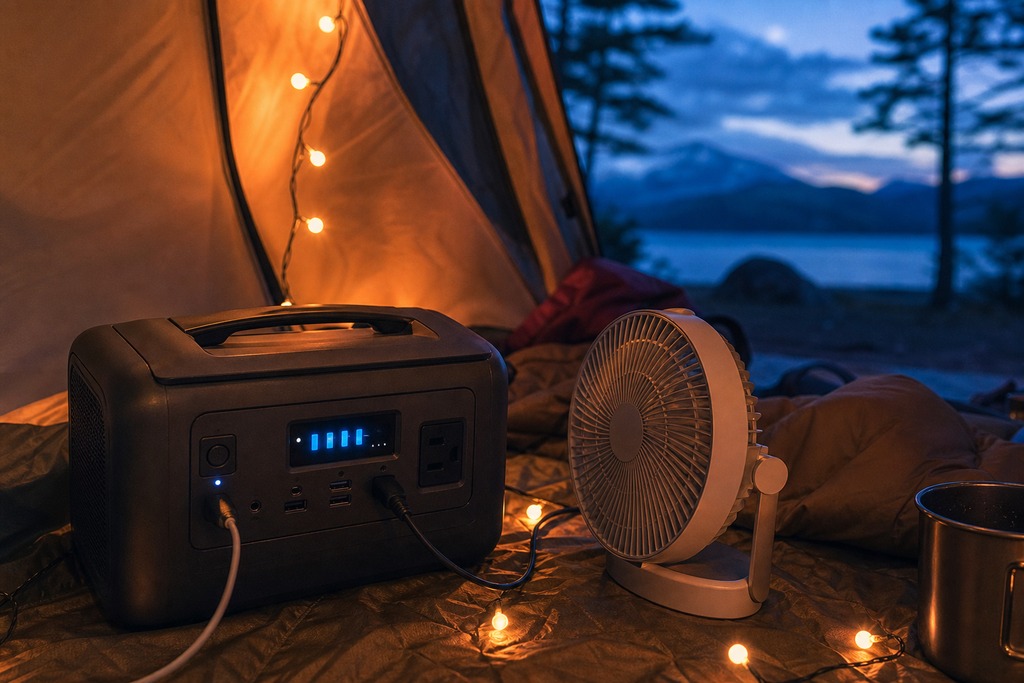
Five brands dominate the camping market, and each has carved out a clear identity. Knowing what each one is known for narrows your search before you ever compare spec sheets.
- Jackery is the beginner-friendly default: simple, reliable, well-supported, and stocked everywhere. Its Explorer line runs from featherweight tent units to expandable weekenders.
- EcoFlow built its reputation on speed. Its stations recharge from the wall faster than almost anyone else, which is why they anchor the "fast recharge" picks in nearly every tier.
- Bluetti competes on capacity and value, pricing its large basecamp and RV units below rivals while still shipping long-life LiFePO4 cells.
- Anker pairs quick charging with the longest warranties in the category, up to five years, making it the safe pick if you want peace of mind.
- Goal Zero leans into rugged, weather-resistant builds favored by overlanders, and its stations pair cleanly with the brand's own Nomad solar panels.
Match the brand's strength to your priority — ease of use, recharge speed, price-per-watt-hour, warranty, or durability — and the model-by-model comparison below gets much shorter.
Recommended models by camping style
Below is the core comparison, grouped by how you camp. Every unit here is a car-to-campsite tool: even the lightest weigh about 7 lbs, so none of them belong in a backpack.
| Model | Capacity (Wh) | Output (surge) | Battery | Weight | Best for |
|---|---|---|---|---|---|
| Jackery Explorer 300 | 293 | 300W (500W) | NMC | ~7 lbs | Day trips, phones, lights |
| Anker 521 PowerHouse | 256 | 200W | LiFePO4 | ~8 lbs | Ultralight, frequent use |
| EcoFlow River 2 | 256 | 300W (600W) | LiFePO4 | ~7.7 lbs | Fast recharge, small loads |
| EcoFlow River 2 Max | 512 | 600W (1,200W) | LiFePO4 | ~13.4 lbs | Light car camping |
| EcoFlow River 2 Pro | 768 | 800W (1,600W) | LiFePO4 | ~17 lbs | Weekend car camping |
| Bluetti EB55 | 537 | 700W (1,400W) | LiFePO4 | ~16.5 lbs | Value weekend unit |
| Bluetti AC70 | 768 | 1,000W | LiFePO4 | ~22.5 lbs | Weekend, higher output |
| Goal Zero Yeti 500X | 505 | 300W (1,500W) | NMC | ~13 lbs | Rugged, light loads only |
| EcoFlow Delta 2 | 1,024 | 1,800W (2,700W) | LiFePO4 | ~27 lbs | CPAP + fridge, fast charge |
| Jackery Explorer 1000 v2 | 1,070 | 1,500W (3,000W) | LiFePO4 | ~23.8 lbs | All-round weekender |
| Jackery Explorer 1000 Plus | 1,264 (to 5kWh) | 2,000W | LiFePO4 | ~32 lbs | Growing power needs |
| Anker SOLIX C1000 | 1,056 | 1,500W | LiFePO4 | ~27.6 lbs | Fastest wall recharge |
| Bluetti AC200L | 2,048 (to 4,096) | 2,400W (4,800W) | LiFePO4 | ~48.5 lbs | Basecamp, appliances |
| Bluetti AC200MAX | 2,048 (to 8,192) | 2,200W | LiFePO4 | ~62 lbs | Stationed RV/basecamp |
| Anker PowerHouse 767 | 2,048 | 2,400W | LiFePO4 | ~44 lbs | High-demand off-grid |
| Goal Zero Yeti 6000X | 6,071 | : | : | heavy | Extended off-grid living |
Jackery Explorer 300
At 293Wh and about 7 lbs, this is the do-the-basics unit for tent nights and day trips. It keeps phones, cameras, a tablet, and lights alive for a weekend without weighing down the trunk.
Pros:
- Genuinely light and easy to carry one-handed
- Simple, reliable, well-supported brand
- 500W surge handles small startup spikes
Cons:
- NMC chemistry fades faster than LiFePO4
- 300W output won't run any heating appliance
- Too small for a fridge over a full trip
Best for: Occasional campers who only charge electronics and lights.
EcoFlow River 2 Pro
768Wh with 800W continuous (1,600W surge) and LiFePO4 cells at ~17 lbs: this is the weekend car-camping sweet spot. It runs a 12V fridge, a laptop, and a CPAP across a 2–3 night trip, and refills fast from the wall.
Pros:
- Enough output for most non-heating appliances
- LiFePO4 rated for 3,000+ cycles
- Very fast AC recharge; solar input up to 220W
Cons:
- 17 lbs is a real lift over rough ground
- Still can't run a kettle or microwave
- App features are overkill for light users
Best for: Weekend car campers running a fridge plus electronics.
Goal Zero Yeti 500X
A rugged, premium 505Wh unit at ~13 lbs, popular with overlanders for its build. Note the catch: its continuous output is only 300W, weak for the price, so treat it as a light-load station despite the 1,500W surge figure.
Pros:
- Tough, weather-resistant construction
- Lighter than most 500Wh competitors
- Pairs cleanly with Goal Zero Nomad panels
Cons:
- 300W continuous is low for a 500Wh unit
- NMC chemistry, ~500–800 cycles
- Premium pricing for the capacity
Best for: Overlanders who value durability and only run small devices.
EcoFlow Delta 2
1,024Wh, 1,800W continuous (2,700W surge), LiFePO4, ~27 lbs: the step up that finally runs heating appliances. It hits 80% charge in about 50 minutes on the wall and is expandable if your needs grow.
Pros:
- 1,800W output runs coffee makers and small appliances
- Extremely fast wall recharge
- Expandable capacity with add-on batteries
Cons:
- 27 lbs is trunk-and-cart territory
- Overkill for phone-and-light trips
- Higher price than weekend units
Best for: Van lifers and campers who cook or run a fridge plus CPAP.
Anker SOLIX C1000
1,056Wh and 1,500W continuous at ~27.6 lbs, with a standout charging trick: 0–100% in 58 minutes from a wall outlet. If you routinely forget to charge before leaving, this is your insurance.
Pros:
- Full recharge in under an hour
- LiFePO4 with a long 5-year warranty
- Strong 1,500W output
Cons:
- Heavy for its capacity class
- No expandable battery on the base unit
- More than casual campers need
Best for: Forgetful campers and anyone who tops up between short stops.
Bluetti AC200L
2,048Wh (expandable to 4,096Wh) with 2,400W continuous and 4,800W surge, LiFePO4, ~48.5 lbs. This is a stationed basecamp and RV unit: it runs microwaves and induction cooktops, but at nearly 50 lbs you set it down once and leave it.
Pros:
- Runs high-draw kitchen appliances
- Huge, expandable capacity for multi-day off-grid
- Massive 4,800W surge headroom
Cons:
- ~48.5 lbs: not something you carry far
- Expensive; wasted if you only charge phones
- Cold weather cuts into that big capacity
Best for: RV owners and fixed basecamps running real appliances.
Recharging off-grid: solar, car, and wall
You refill a power station three ways, and they're not close in speed. Wall AC is fastest: premium LiFePO4 units hit 80% in under an hour and full charge in roughly 50–58 minutes on the quickest models, so top off at home before you leave. Solar keeps you off-grid indefinitely: a 100W panel adds roughly 300–500Wh on a sunny day, and a 1,000Wh unit refills in about 5–8 hours with 200W of panels, or 10–14 hours with a single 100W. The 12V car port is the slowest at 8–14 hours, best used as a trickle while you drive.
Two rules save disappointment. Buy panels rated for an MPPT charge controller, which pulls up to 30% more power in variable light than older PWM. And expect only 60–80% of a panel's rated wattage in the real world after heat, sun angle, and passing clouds — a "200W" panel is a 130–160W panel on most days.
| Solar panel | Wattage | Best for |
|---|---|---|
| Jackery SolarSaga 100W | 100W | Small–mid stations |
| EcoFlow 220W Bifacial | 220W | Fast solar recharging |
| Bluetti PV200 / SP200 | 200W | High-efficiency charging |
| BougeRV 200W | 200W | Budget-friendly option |
Price by capacity
Price tracks capacity closely, and LiFePO4 units sit at the higher end of each band but earn it in lifespan. As of the current market, expect these ranges — always check the live listing, since sales swing prices hard.
| Capacity | Typical price |
|---|---|
| 200–300Wh | $200–$350 |
| 500–800Wh | $400–$700 |
| 1,000–1,500Wh | $700–$1,200 |
| 2,000Wh+ | $1,200–$3,500+ |
Buying tips
A few habits separate a station you love from one you resent hauling.
- Prioritize LiFePO4 if you camp more than a few times a year — 3,000+ cycles versus 500–800 for NMC pays for itself.
- Match output watts to your highest-draw device, not just capacity — this is the number that decides what runs.
- Weigh the unit against how far you actually carry it from the car.
- Prefer DC and USB-C ports where possible to skip the ~15% AC inverter loss.
- Want pass-through charging if you'll power devices while recharging.
- Consider expandable models (Jackery Plus, EcoFlow Delta) if your needs may grow.
- A companion app over Bluetooth or Wi-Fi lets you watch battery drain in real time.
- Check the warranty — 2–5 years is standard, LiFePO4 units often 5+.
- Pre-charge to 100% before the trip; store at ~50% in a cool, dry place between trips.
Who should NOT buy a portable power station
A power station is the wrong tool for several campers, and it's honest to say so. Backpackers and thru-hikers counting grams should skip these entirely — even the lightest units weigh 7–8 lbs, and they're built to sit by a car, not ride in a pack. Carry a lithium power bank instead. Phone-only campers who never plug in more than a couple of devices are overpaying; a 20,000mAh power bank does the job for a fraction of the weight and cost. Anyone hoping to fly with one is out of luck — any station over 160Wh is banned from carry-on luggage, and all are banned from checked luggage; stations between 100Wh and 160Wh may be allowed in carry-on with airline approval, but that covers essentially none of the units in this guide. These are ground-transport tools only.
Two more limits worth respecting. If you plan to boil water or run a microwave, capacity alone won't do it — you need 1,000W+ of continuous output, so check that spec or accept cold coffee. And deep-winter campers should proceed with caution: performance drops in freezing temperatures, and charging a frozen LiFePO4 cell can permanently damage it. Keep the unit insulated and warm it before charging in the cold.
FAQ
Which portable power station is best for camping?
There's no single best — it depends on your trip. For weekend car camping, the EcoFlow River 2 Pro (768Wh, 800W) hits the balance of capacity, output, and weight. For van life or cooking off-grid, step up to the EcoFlow Delta 2 or Jackery Explorer 1000 v2. For light tent trips, the Jackery Explorer 300 is plenty.
How big of a portable power station do I need for camping?
Size it by two numbers. For phones and lights only, 200–500Wh is enough. For weekend car camping with a fridge and CPAP, 500–1,000Wh is the sweet spot. For extended off-grid or RV use with appliances, go 1,000–2,000Wh+. Then confirm the continuous output (W) clears your highest-draw device.
Is it worth buying a portable power station?
Yes, if you car camp regularly and want silent power for a fridge, CPAP, lights, and electronics without gas fumes or engine noise. It's not worth it if you only charge a phone occasionally, a power bank is cheaper and lighter, or if you backpack, since even small units weigh 7–8 lbs.
How long will a 300W power station last?
A 300Wh station (often the capacity of "300W" units like the Jackery Explorer 300) charges a smartphone roughly 21–27 times, runs a 10W LED light for about 25 hours, or powers a 45W 12V fridge for 5–6 hours of compressor runtime. Use (Wh × 0.85) ÷ device watts to estimate any load, accounting for inverter loss.
References
- National Park Service, generator and quiet-hours guidance for campgrounds
- Manufacturer spec sheets: Jackery, EcoFlow, Bluetti, Anker, Goal Zero
- FAA / TSA lithium battery rules for air travel (160Wh carry-on limit for unapproved batteries; airline approval required for 100–160Wh)