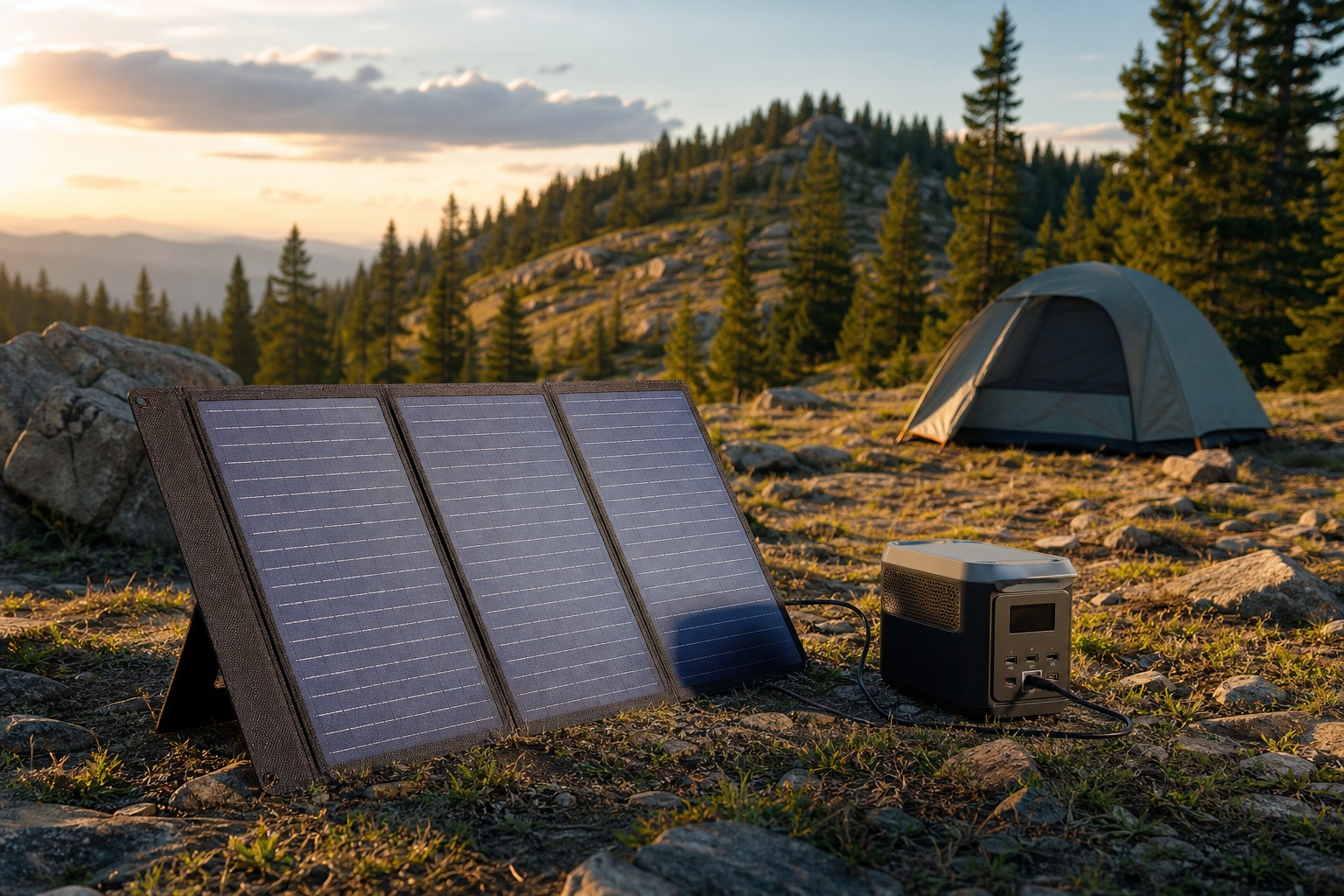
How much solar power you need for camping comes down to two numbers: not the single wattage everyone asks about. For most weekend and car campers, a 100–200W panel paired with a 500–1,000Wh power station is the sweet spot. The panel, measured in watts, sets how fast you make power. The battery, measured in watt-hours, sets how much you store and run after the sun drops behind the ridge. Size both with a five-minute sum: multiply each device's watts by the hours you run it, total those daily watt-hours, then match the battery and panel to that number. The one thing that swings the whole answer? Whether you're carrying a 12V fridge.
That framing matters, because "how many watts of solar do I need" is the wrong question on its own. A panel isn't something you plug a phone into. It makes nothing at night and can't run a fridge alone. The battery runs your gear; the panel only refills it during daylight. Get those two jobs straight, and the rest is arithmetic you can do at the trailhead.
Quick Answer by Camping Style
Match your setup to how you actually camp. The ranges below cover the vast majority of trips, from a phone-only backpacking kit to a full-time van build.
| Camping Style | What You'll Run | Solar Panel (W) | Battery / Power Station (Wh) |
|---|---|---|---|
| Backpacking / minimalist | Phone, headlamp, GPS watch | 15–50W folding | 10,000–20,000mAh power bank (≈35–75Wh) |
| Car / weekend camping | Phones, lights, fan, small speaker | 60–200W | 200–500Wh |
| Overlanding / extended | 12V fridge, laptop, drone charging | 100–200W | 500–1,000Wh |
| RV / van life (full-time) | Fridge, water pump, laptops, small appliances | 200–600W+ | 1,000–4,000Wh+ |
Pick the row that matches your heaviest device, not your lightest. The jump between car camping and overlanding is almost entirely the fridge: that one appliance is the reason the battery column doubles.
The Two Numbers You're Actually Sizing
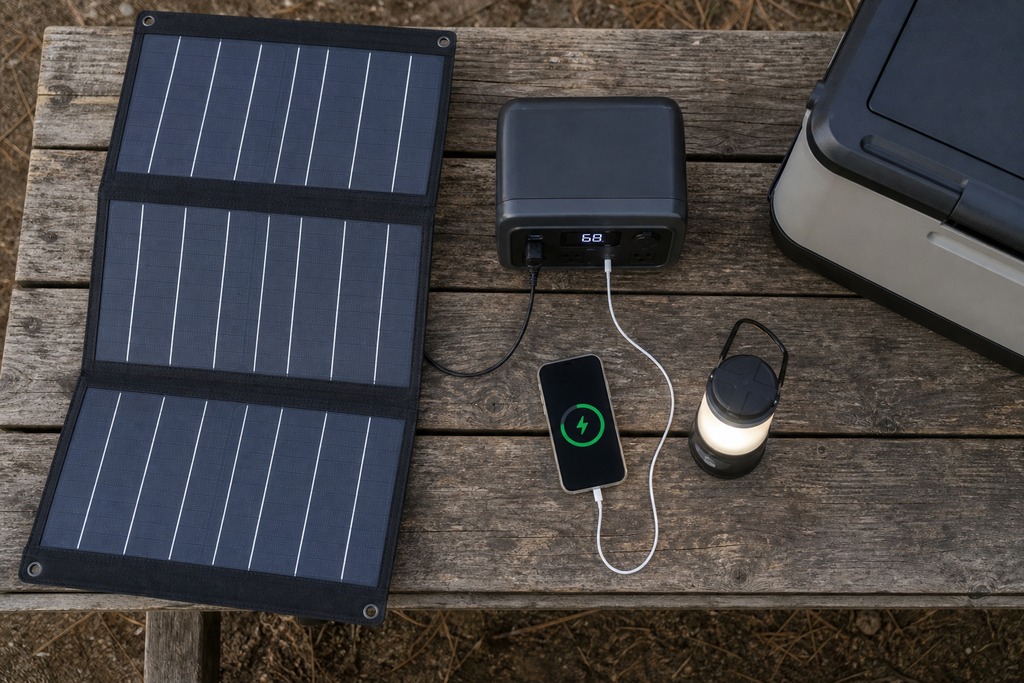
You're sizing two separate specs, and mixing them up is the most common mistake I see. Watts is a rate: how fast a panel makes power, or how fast a device eats it. A 100W panel makes power at up to 100 watts in strong sun. A 45W laptop pulls 45 watts while it's plugged in. Watt-hours is a quantity: how much energy the battery holds, or how much a device burns over time. Run that 45W laptop for two hours and you've spent 90 watt-hours.
The panel is rated in watts because its job is a rate: refill the battery as fast as the sun allows. The battery is rated in watt-hours because its job is a quantity: hold enough energy to carry your devices through the evening and a cloudy morning. A big panel won't help if the battery is too small to store what it makes. And a big battery does nothing if the panel can't refill it before you drain it. Two jobs, two numbers, both required.
Why You Always Need a Battery, Not Just a Panel
A panel by itself powers nothing you'd use at camp. Panels only produce while the sun hits them, and camping loads run mostly after dark: lights, a fan, a fridge cycling overnight, your phone on the charger while you sleep. Even a 400W array runs no fridge and no phone once the light goes. The battery is what actually runs your devices, day or night. The panel just tops it back up when the sun returns.
I watched a first-timer on a Utah overlanding trip wire his new fridge straight to a folding panel, proud of skipping the "expensive battery." It hummed along fine until a bank of afternoon clouds rolled in. The panel's output collapsed, and the compressor cut out. By evening his food was warm. The U.S. Department of Energy draws the same line between a battery's energy capacity, how much it holds, and a panel's instantaneous power, which is exactly why solar and storage are always paired. Panel refills, battery runs. Never plan around one without the other.
What Your Devices Actually Draw
These are the reference numbers you'll plug into the math. The draw column is the rate a device pulls; the daily-use column is a realistic full day's energy for camping use. Always check your own device's power brick: the printed figure beats any table.
| Device | Power Draw (W) | Typical Daily Use (Wh) |
|---|---|---|
| Smartphone charge | 5–10W | 10–20Wh |
| Tablet / laptop | 30–65W | 50–120Wh |
| LED lights / lantern | 3–10W | 20–50Wh |
| Portable fan | 5–25W | 50–150Wh |
| 12V fridge | 40–60W (cycles on and off) | 300–600Wh/day |
| CPAP machine | 30–60W | 200–700Wh/night |
| Small TV | 30–50W | 100–200Wh |
| Electric kettle / induction | 800–1,800W | brief bursts only |
Notice the two tiers. Everything from phones through the TV lives comfortably under 200Wh a day. The fridge alone matches all of them combined, and the kettle sits in a different universe entirely.
Solar Power for Camping: How Much You Actually Need
Solar Power Needs for Camping
Before those numbers mean anything for your trip, settle one variable per device — the one people fudge most:
- Estimate daily use hours: How many hours will you run it per day? (e.g., Laptop for 2 hours, fridge for 24 hours but it only runs 30% of the time = 8 hours).
Size Your Own System in Four Steps
Here's the whole method, worked with a common weekend-plus-fridge load that lands near 720Wh per day. Do this once for your actual gear and you'll never guess again.
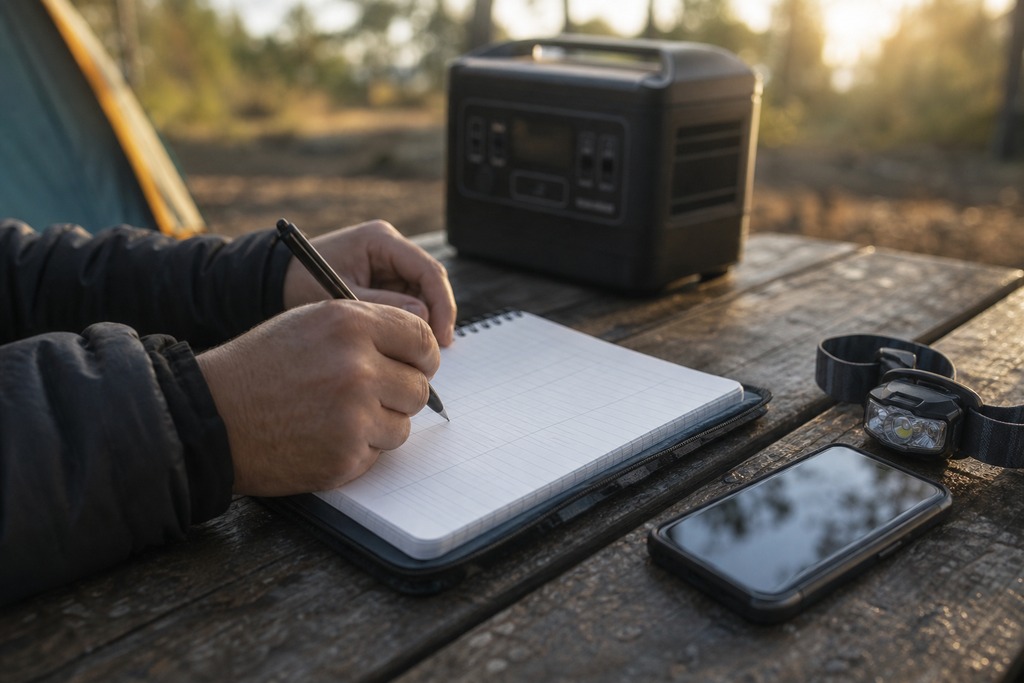
- Add up your daily watt-hours. List every device, multiply its watts by the hours you run it, and total the column. A typical fridge-carrying camper: six phone charges (90Wh) + LED lights (30Wh) + laptop (120Wh) + fan (80Wh) + 12V fridge (400Wh) = 720Wh per day. That fridge figure already accounts for the compressor cycling on and off, not running flat-out for 24 hours.
- Size the battery to 1.5–2× your daily use. That reserve covers one cloudy day when the panel underperforms. 720Wh × 1.5 lands near 1,000Wh for a single day of buffer; go to roughly 2,000Wh if you want to sit out two overcast days with no other charging.
- Size the panel from daily watt-hours ÷ (peak sun hours × 0.75). Peak sun hours are the roughly 4–5 strong midday hours, not total daylight. At 4 hours: 720 ÷ (4 × 0.75) = 240W. Round up to a 250–300W panel. The 0.75 already bakes in a buffer for heat, wiring, and imperfect angle; add another step up if you expect shade or winter light.
- Account for depth of discharge. A battery's usable energy isn't its full rating. LiFePO4 (lithium) power stations can be drained 80–100% of the way. Lead-acid and AGM should only go to 50%, so a 1,000Wh AGM battery gives you about 500 usable watt-hours: you'd need to buy double the rating to match a lithium unit.
Why Rated Wattage Isn't What You Get
A panel almost never delivers its sticker number, and planning around that number is how people end up with dead batteries. A 100W panel realistically yields about 400–500Wh across a good-sun day, not the 1,200Wh a flat multiplication suggests. Here's what eats the difference:
- Peak sun hours vary by place and season: roughly 3 hours in a cloudy northern winter versus 6+ in a desert summer.
- Shade on even one cell can halve a panel's output: a single branch or awning edge takes down the whole array.
- Heat cuts output 10–25%: panels lose efficiency as they bake, so a scorching afternoon underdelivers.
- Flat versus sun-angled mounting differs 10–30%: a panel laid flat on a roof loses power a tilted, tracked panel keeps.
- Real-world planning number: treat a 100W panel as ~400–500Wh/day in good sun, and less in shade, clouds, or heat.
For your specific site, NREL's free PVWatts calculator estimates production by location and season if you want to move past the rules of thumb.
The Fridge: and Other Appliances That Change the Math
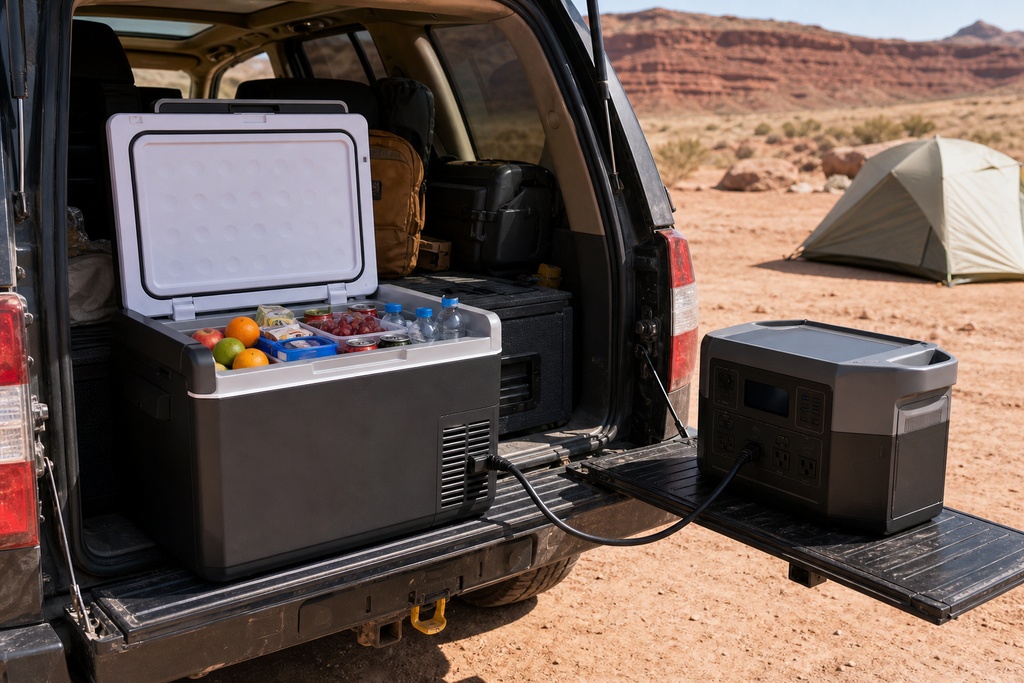
The 12V fridge is the tipping point where a casual kit has to scale up. Below it, you're in 100W-and-a-power-bank territory; add one and you're buying real storage. A few appliances, meanwhile, simply don't belong on camping solar at all.
| Appliance | Typical Draw | Effect on Your Setup |
|---|---|---|
| 12V fridge | 300–600Wh/day | Step up to ≥100–200W panel + 500–1,000Wh battery |
| CPAP machine | 200–700Wh/night | Size the battery to a full night's run; a heated hose or humidifier adds more |
| Electric kettle | 1,000–1,500W, minutes only | Big instant draw; needs a large inverter and drains the battery fast |
| Induction cooker | 800–1,800W | Impractical to sustain on camping solar |
| Electric heater / AC | 1,000W+ continuous | Off the table for a portable setup |
| Propane cooking / heating | : | Dramatically cuts the solar you need |
The lesson under this table: don't try to solve cooking and heating with more panels. A two-burner propane stove and a canister heater sidestep the biggest loads entirely and let a modest solar setup handle everything else. Cook on gas, run electronics on solar.
If You Build Your Own
Skip this section if you're buying an all-in-one power station: it already contains these parts, matched and wired. If you're assembling a 12V system yourself, four separate components each need the right pick.
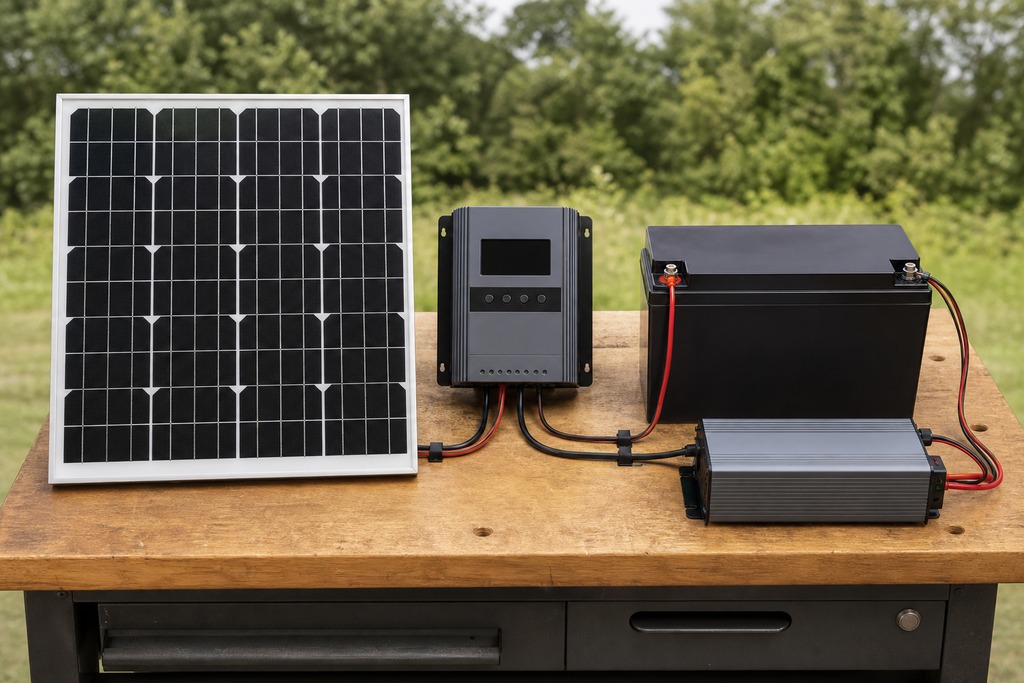
| Component | What to Choose | Why It Matters |
|---|---|---|
| Panels | Monocrystalline | 15–20% more efficient than polycrystalline, and better in low light |
| Charge controller | MPPT | 90–95% efficient versus PWM's 70–80%: real energy off the panel |
| Battery | LiFePO4 | Lighter, 3,000+ cycles, safe to deep-discharge |
| Inverter | Pure sine wave, sized to your highest simultaneous AC draw | Protects laptops and CPAP; a 1,000–2,000W unit covers most camp loads |
Size the inverter to the most AC wattage you'll ever pull at one time, not your daily total. Run a 1,500W kettle and you need at least a 1,500W inverter, even though the kettle only runs for minutes.
Who Should Not Buy a Big Solar Setup
Backpackers should not buy a 100W-plus system. If your load is a phone, a headlamp, and a GPS watch, a 15–25W folding panel and a 10,000–20,000mAh power bank cover you, and hauling more is dead weight up every switchback. I've watched people carry a briefcase panel on a three-day hike and use maybe a fifth of it — the extra pound and a half bought nothing.
You also shouldn't buy solar to run electric cooking, heating, or air conditioning. A kettle, induction burner, space heater, or AC unit draws 800–1,800W continuously or in bursts, and sustaining that draws down a camping battery in minutes. Propane handles those jobs for a fraction of the weight and cost. And don't buy a bigger panel to rescue an undersized battery, or a bigger battery to rescue a weak panel — those are two separate sizing jobs, and oversizing one won't fix the other.
Bottom Line — Is 400W Enough?
There's no yes-or-no answer to "is 400W enough" without knowing your daily watt-hours and the battery it's feeding — the panel number alone can't tell you. What holds up across every setup: casual tent and car campers do fine on a 100W panel plus a 300–500Wh power station, which keeps phones, lights, and a fan running indefinitely. Add a 12V fridge and you step up to roughly 200W of solar and a 1,000Wh battery. Backpackers drop all the way to a 20W panel and a power bank. "Enough" is decided by the battery the panel is paired with and the load you put on it, never by the panel wattage alone. Size the two numbers together, and 400W is either overkill or not enough — depending entirely on what's plugged in.
FAQ
Is 400W solar enough for RV?
For a weekend or part-time RV running lights, a 12V fridge, a water pump, and device charging, 400W paired with a 1,000–2,000Wh battery is comfortable and refills well in good sun. Full-time living with more appliances usually wants 600W+ and 2,000–4,000Wh of storage. Neither will run air conditioning or electric cooking — those need shore power or a generator.
Will a 400W solar panel run a fridge?
Not by itself — no panel runs anything directly, because it makes no power after dark. Paired with a 500–1,000Wh battery, 400W of solar easily refills a 12V fridge's 300–600Wh daily appetite with reserve to spare, even on a partly cloudy day. The battery runs the fridge around the clock; the 400W just tops it back up each afternoon.
How much solar power does it take to run a camper?
It depends on your daily watt-hours. A small camper with a fridge, lights, and device charging (roughly 400–700Wh/day) runs well on 200–300W of solar and a 1,000Wh battery. A full-time van or RV with more appliances (1,000–3,000Wh/day) needs 400–600W+ and 2,000–4,000Wh of storage. Total your devices first, then size to that.
Is 200W solar enough for a camper?
For most weekend campers running phones, lights, a fan, a laptop, and a single 12V fridge, a load near 700Wh a day, yes, 200W paired with a 500–1,000Wh battery keeps up. It stops being enough the moment you add electric cooking, a space heater, or air conditioning, which no practical camping solar setup can sustain.
References
- U.S. Department of Energy, "Solar Integration: Solar Energy and Storage Basics" — energy.gov (distinction between battery energy capacity and instantaneous power capacity, and why solar and storage are paired).
- National Renewable Energy Laboratory (NREL), PVWatts Calculator — pvwatts.nrel.gov (location- and season-specific solar production estimates).
- Manufacturer spec sheets for portable power stations and 12V compressor fridges (Jackery, EcoFlow, Bluetti, Anker class) for device draw and battery capacity figures.