Stop asking which Alpha Direct jacket is warmest. The garment doesn't hold the answer: the shell over it does.
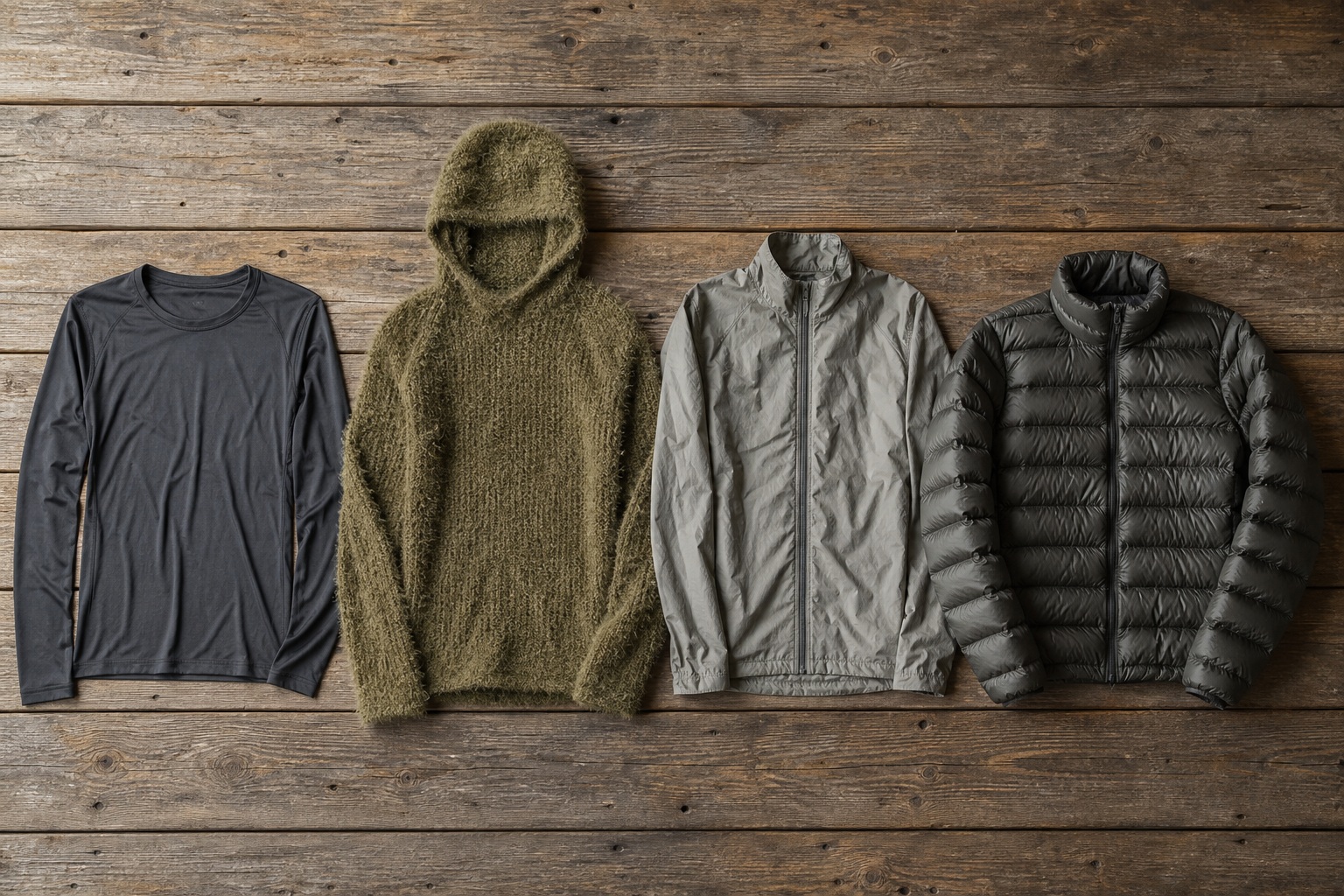
Build your Alpha Direct layering system for backpacking as four moving parts: a thin base layer, the Alpha Direct piece itself, a wind or rain shell, and a separate camp puffy. Then run your temperature off the shell, not the fleece. That's where most people go wrong. Alpha Direct gives you almost no warmth the moment a breeze hits it, so how warm you feel depends on what you put over it. Wear it only while moving. Keep a real puffy for standing still. Do that, and this kit carries you from a sweaty climb to a frozen ridge without soaking through your layers.
For most three-season trips, the safe first buy is 90 gsm Alpha Direct: dense enough to matter, thin enough to breathe. Everything else hangs off that choice: the base layer under it, the shell that acts as your dial, and the puffy that takes over when you stop.
The Alpha Direct Layering System for Backpacking
Most backpackers grow up with a three-layer wardrobe: a base against the skin, one insulating midlayer, and a shell on top. That setup asks the midlayer to cover the whole day, a job an ordinary fleece or light puffy can fudge. Alpha Direct won't play along, for the reason this whole system exists — it warms a working body and little else — so it splits that one midlayer into two specialized pieces. The result is a four-piece kit where the model most people know is three.
That extra piece is why this is a system and not just a jacket, and it's also what makes the kit modular. Each part does one narrow job, so you can add or drop it as a unit without opening a gap in your coverage. You scale up for cold and down for heat by changing which of the four you pack — the sample setups further down make that concrete — rather than hunting for one garment that survives the whole temperature range. No such garment exists, which is precisely why the system does.
What Polartec Alpha Direct Actually Is
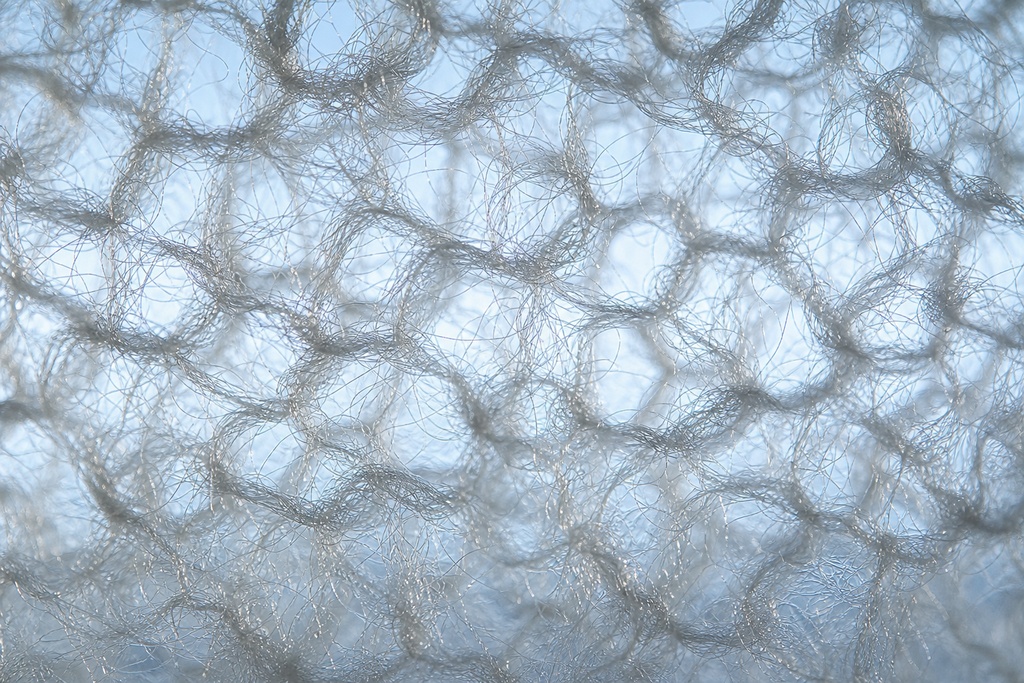
Polartec Alpha Direct is active insulation: a lofted, exposed knit with no real face fabric, so it dumps heat and sweat vapor almost the instant you start moving. Picture a grid-less fleece with a fluffy, spider-web structure open to the air. That openness is the whole point. Vapor escapes before it can condense in your baselayer, which is why you can grind uphill under a pack without soaking out the way you would in a puffy or a dense fleece.
Polartec built the original Alpha for U.S. Special Operations forces who needed to move hard, then stop, in the cold. Think start-and-stop work, where a sealed jacket cooks you on the climb and a bare shirt freezes you at the halt. That heritage explains the design goal, not your purchase. Polartec calls Alpha active insulation for "changing, stop-and-start conditions": a polite way of saying it's meant to be regulated, not to be your only warm layer.
Here's the rule that breaks the usual thinking: the warmth comes from the shell, not the Alpha. Stand still on an exposed ridge in nothing but an Alpha hoodie and a light wind, and you'll be cold in minutes, because the same air that pulls your sweat out also pulls your body heat straight through. Cover it with a wind shirt and that same hoodie feels twice as warm. So the false choice people set up, warm puffy versus breathable fleece, misses the point. Alpha is neither. It's one moving-only piece of a system.
Alpha Direct vs. Down, Fleece, and Puffies
Alpha Direct breathes far more than any fleece or puffy, dries faster than both, and keeps working when damp: but it gives up a little static warmth to premium down and offers zero wind protection. The numbers make the trade concrete.
| Property | Alpha Direct | Down / synthetic puffy or standard fleece |
|---|---|---|
| Air permeability | >100 L/m²/s | Fleece 40–60 L/m²/s; windshirt <10 L/m²/s |
| Drying speed | 2–3× faster than a synthetic puffy; faster than down | Slow; down slowest of all when wet |
| Static warmth-to-weight | ~10–15% below 800-fill down when sitting still | 800-fill down sets the benchmark |
| Performance when damp | Keeps insulating | Down collapses; synthetics hold up |
| Packability | Very small, slightly bulkier than high-fill down | High-fill down packs smallest |
Read that top row twice. Alpha moves more than ten times the air of a wind shirt. That's a feature while you climb and a liability while you loaf. It's exactly why the shell and the puffy aren't optional extras: they're the other half of the tool.
The Four-Part System
The system is four layers with four distinct jobs, and the shell is the one you actually use to control heat. The base layer manages sweat, the Alpha adds warmth while you move, the shell traps or vents that warmth on demand, and the puffy handles the cold once you stop.
| Layer | What it does | What to use |
|---|---|---|
| Base layer | Wicks sweat, protects the Alpha from skin oils and abrasion | Thin merino ~150 gsm or synthetic (Capilene); optional against skin in mild temps |
| Alpha Direct | Active warmth while moving | 90 gsm hoodie (e.g., Senchi Designs) |
| Wind shell | Your temperature dial: traps heat, blocks wind, vents by unzipping | Patagonia Houdini, EE Copperfield or Visp, Montbell Tachyon |
| Rain shell | Rain, wet snow, severe wind | OR Helium, Montbell Versalite, Frogg Toggs |
| Camp puffy | Static warmth once you stop | Down or synthetic such as Enlightened Equipment Torrid |
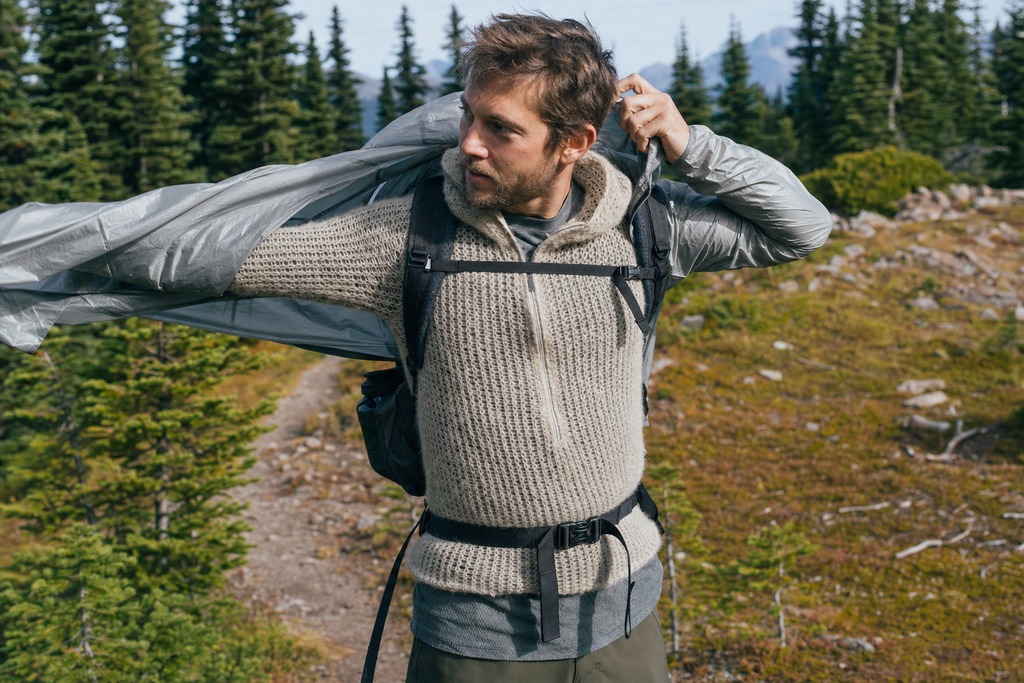
Here's the move that makes it click. When you heat up on a climb, you unzip or peel the shell, not the Alpha. Pulling the fleece on and off every twenty minutes is the mistake that convinces people the whole idea doesn't work. Leave the Alpha on and let the shell do the fine-tuning: full-zip open when you're working, zipped and hood up when the wind bites, off and stashed when the sun comes out.
The wind shirt and the rain shell are two different tools, not interchangeable. A wind shirt is breathable and blocks moving air. A rain shell is waterproof and less breathable: warmer, but prone to feeling clammy on a hard climb. A moderately breathable wind shell manages your moisture better than a fully windproof one, so reach for the wind shirt first and save the rain shell for actual weather. And that camp puffy is a separate static layer. It's not the Alpha in a heavier gauge, and it's not the same product as the wind shells. Enlightened Equipment's Torrid is a synthetic puffy; their Copperfield and Visp are wind shirts. Don't blur one brand's shelf into a single item.
Choosing Your Alpha Direct Weight
Pick your Alpha by how hot you run and how cold you hike, not by which hoodie shaves the most ounces: and remember that gsm is fabric density, not the garment's total weight. A 90 gsm hoodie with a hood, pockets, and a full zip can outweigh a 120 gsm pullover.
| GSM (fabric density) | Best conditions | Rough active-hiking range | Typical hoodie weight |
|---|---|---|---|
| 60 gsm | Warm hikers, summer mountains, maximum venting | ~40–60°F (4–16°C) | ~3–4.5 oz |
| 90 gsm | Best general three-season pick | ~30–50°F (−1–10°C) | ~4.5–6 oz |
| 120 gsm | Cold sleepers, shoulder season, mild winter | ~20–40°F (−7–4°C) | ~6–8 oz |
| 136–190 gsm | Steady cold, winter, low output | Varies |
The 90 gsm is the safest first purchase for a reason: it covers the widest slice of three-season conditions and vents hard enough that you rarely regret the warmth. Treat those temperatures as tuning ranges, not safety limits. A fast, warm-running hiker will wear 60 or 90 gsm below the listed numbers, while someone who runs cold reaches for the shell, or the next weight up, much earlier. For a real-world anchor, a medium 90 gsm LightHeart Gear hoodie lists at 5.2 oz (147 g); minimalist 60 gsm pieces come in under 4 oz. The lightest option isn't automatically the right one. 60 gsm isn't "the one everyone should get to cut weight": it's the one for people who overheat and hike in mild cold.
Which Alpha Direct Garments to Consider
Because major brands rarely sell garments with the insulation exposed as the face, small cottage makers own this category. Compare on gsm and weight first, then availability.
| Brand / model | GSM | Approx. weight | Notes |
|---|---|---|---|
| Senchi Designs (Lark / Merlin) | 60 / 90 | ~3–5 oz | Most well-known; highly customizable; long lead times |
| LightHeart Gear hoodie | 90 | ~5.2 oz | Easier to buy; retail stock |
| Timmermade | 90 / 120 | Custom | Made to order; pairs with their quilts |
| Rab Alpha Flash | : | ~8 oz | More durable; available at retail |
| MYOG (make your own) | 60 / 90 / 120 | Varies | Fabric from Ripstop by the Roll or Discovery Fabrics |
One trap worth checking every season: not every big-brand piece labeled "Alpha" uses the exposed Direct version. Some wrap Polartec Alpha inside a woven face fabric: warmer in wind, but nowhere near as breathable, and not what this system depends on. Some brands have also quietly swapped to a proprietary insulation while keeping the marketing language. Read the current spec sheet before you buy, and confirm the loft is genuinely exposed. And to repeat the one that trips people up: the Enlightened Equipment Torrid belongs in the camp-puffy slot, not on this list.
What to Wear in Each Condition
Match your kit to the thermometer and your effort, then fine-tune with the shell. Use this as a starting grid, not gospel: every line shifts with wind, pace, pack weight, and how hot you personally run.
| Temperature / conditions | What to wear |
|---|---|
| 60–75°F (15–24°C) | Base layer only, or Alpha alone if you run cold |
| 45–60°F (7–15°C) | Base + 60 gsm Alpha |
| 30–45°F (−1–7°C) | Base + 90 gsm Alpha + wind shell |
| Below 30°F (−1°C) | Base + Alpha + shell + puffy |
| Rain / wet snow | Rain shell over Alpha; vent early on climbs |
| Rest breaks and camp | Add the shell immediately, then the puffy if still cold |
The single most-missed line is the last one. The instant you stop, get the shell on before you feel cold. Alpha bleeds heat fast once your engine idles, and chasing warmth after you've already chilled costs far more than staying ahead of it. If the night is near or below freezing, the puffy goes over the top: a wind shirt plus Alpha is not the equal of a real down or synthetic jacket.
Sample Complete Setups
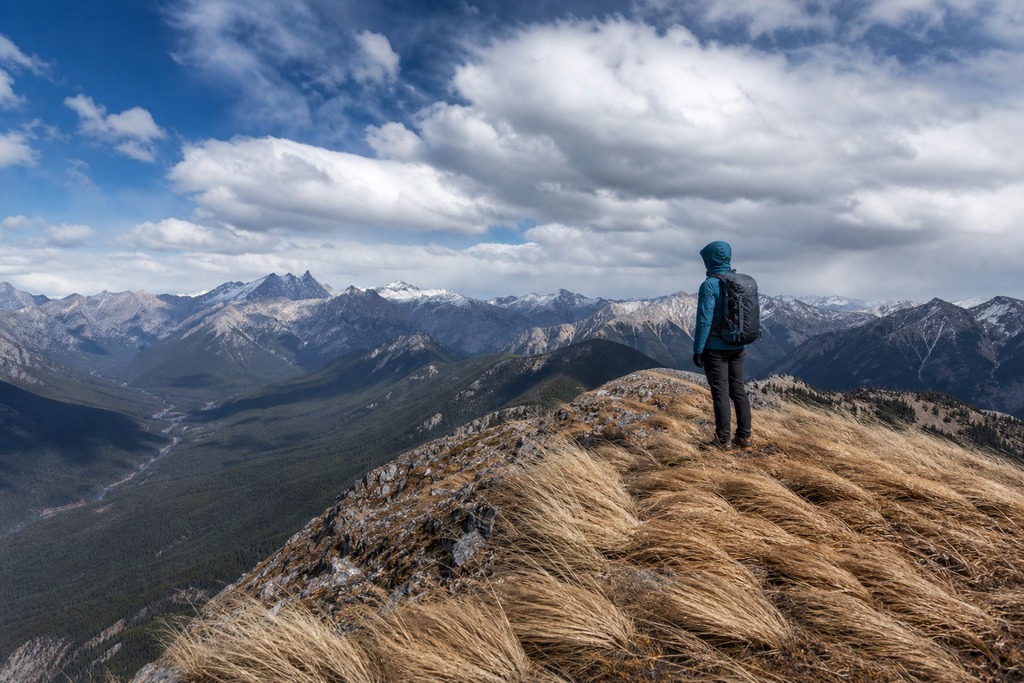
Copy one of these three kits and adjust from there. Each is a full clothing system built around a single Alpha piece.
| Trip type | Full kit |
|---|---|
| Three-season (most common) | Sun hoody + 90 gsm Alpha + ~3 oz wind shirt + light down puffy + rain jacket |
| Warm-weather / high output | Sun hoody + 60 gsm Alpha + wind shirt only |
| Cold / shoulder-season | Base + 120 gsm Alpha + wind shirt + rain shell + warmer camp puffy |
Built this way, a full three-season clothing system lands well under 3 lb beyond your base layers: which is the quiet payoff of the whole approach. You're not carrying a fleece and a puffy and a soft-shell for different temperatures. You carry one thin fleece and let the shell do the range.
Living With the Downsides
Alpha Direct is a specialist, not a low-maintenance layer, and it will let you down if you ignore its limits:
- Fragile: it snags, pills, and sheds fibers, especially when new.
- No wind resistance, so a shell is effectively mandatory.
- Weak static warmth, so you still carry a puffy.
- A magnet for debris — pine needles, burrs, and velcro hooks cling to it.
- Holds odor, because it's polyester.
- Lighter weights can be nearly see-through.
- Cottage brands run limited stock and long lead times.
Make it last by protecting it. Keep a shell over it when you push through brush, or when pack straps ride against the loft — that's where abrasion damage happens fast. Wash it gently on cold, never with fabric softener. Start each climb slightly cool and let the effort warm you, rather than dressing for the trailhead chill. And always layer things over the Alpha, not under it, so nothing crushes the open face that does all the breathing.
Who Should Not Build Around Alpha Direct
Skip this system if you want one garment that simply keeps you warm. Alpha isn't it, and no amount of gsm changes that. It's built to be regulated, and if you won't carry or wear a shell, the whole thing falls apart the first time the wind comes up.
A few other honest "no" cases. For deep-winter, standing-around use (belaying, glassing, sitting in a cold camp for hours) you need real static insulation, not active insulation. For hot summer hiking, especially if you run warm, a good sun hoody or base layer alone is the honest answer, and plenty of fast hikers never carry Alpha in July at all. For low-output activities where you never sweat much, breathability isn't the problem you're solving, so a simple fleece or puffy is cheaper and tougher. And if your trips involve constant hard bushwhacking without a shell over the fabric, expect to wear it out — the exposed loft isn't built for that abuse.
FAQ
Can you wear Alpha Direct against bare skin?
Yes. In mild temperatures, many hikers wear it next to skin, and it's comfortable there. But a thin base layer under it wicks better, shields the fabric from skin oils and abrasion, and adds a little warmth — worth it on multi-day trips where you can't wash the fleece.
Is 60 or 90 gsm Alpha Direct better to buy first?
Buy 90 gsm first unless you clearly run hot. It covers the widest three-season range (roughly 30–50°F while hiking) and still vents hard under a shell. Choose 60 gsm only if you overheat easily or hike mostly in warm mountains.
Do you still need a puffy if you carry Alpha Direct?
Yes — whenever nights get near or below freezing. Alpha is moving-only insulation and loses heat fast the moment you stop, so it doesn't replace a static camp jacket. Carry a separate down or synthetic puffy, like an Enlightened Equipment Torrid, for stops and camp.
Does Alpha Direct work as a sleep layer?
A clean Alpha hoodie can add a few degrees to a quilt or bag, and it feels good against skin. Just don't use it to justify an under-rated sleep system. It supplements warmth; it doesn't create much on its own.
Is Alpha Direct worth it for summer backpacking?
Often not, if you run warm. Above about 50°F at high output, even thin 60 gsm Alpha is frequently too hot, and a sun hoody or base layer alone does the job. Save it for cool mornings, high altitude, and shoulder-season trips.
References
- Polartec, "Alpha" active insulation technical overview — polartec.com/fabrics/insulation/alpha
- Garage Grown Gear, "Alpha Direct Ultralight Fleece Fabric" (fabric-weight overview) — garagegrowngear.com
- Garage Grown Gear, LightHeart Gear 90 gsm Alpha Direct Hoodie product specifications — garagegrowngear.com
- Timmermade, Alpha Direct 4004 Hoodie product page — timmermade.com