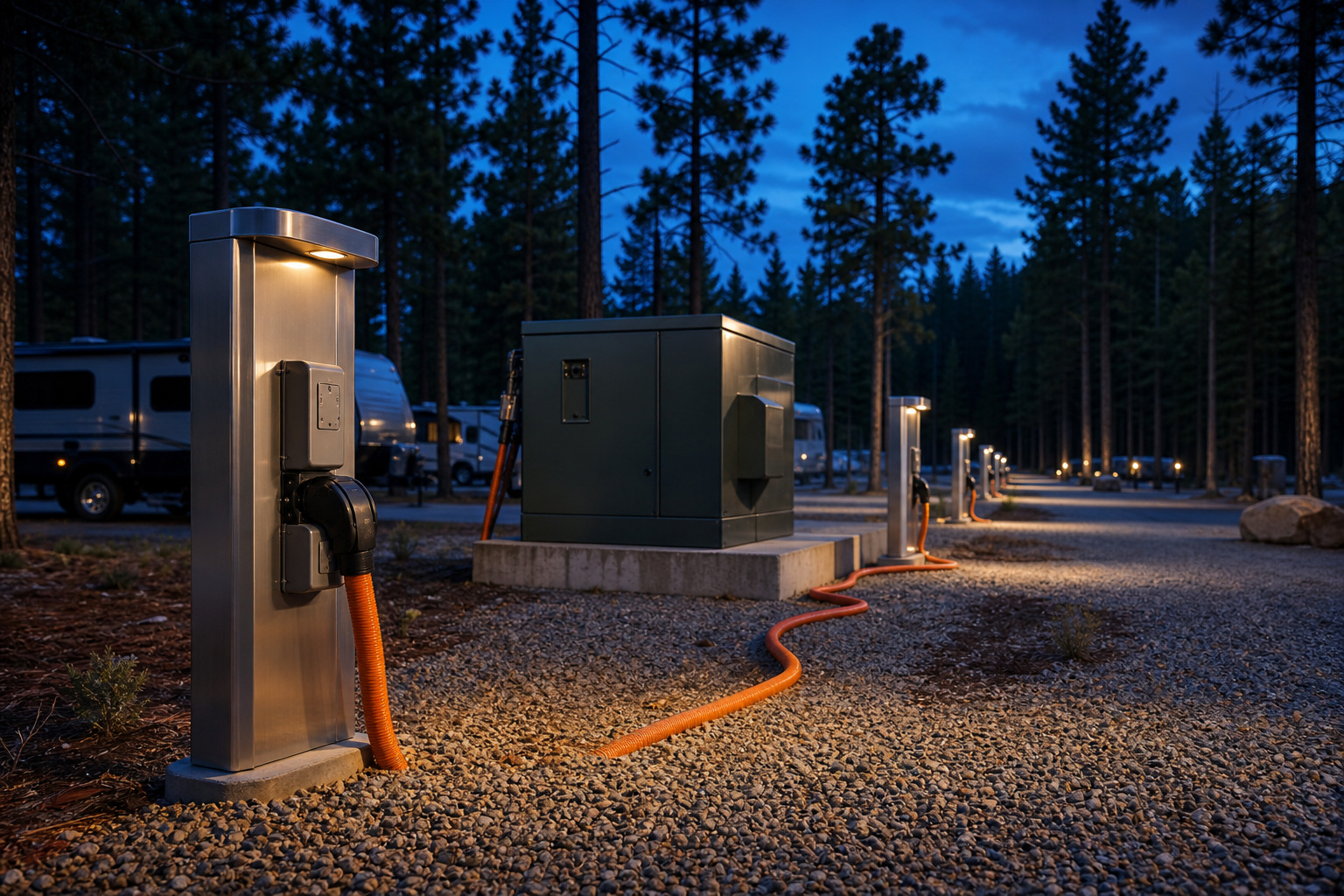
Campground electrification lives or dies at the utility service and load-planning stage: not at the pedestal. Before you shop for power posts, you size the incoming service and transformer. And here's the good news, early: the National Electrical Code lets you build to a fraction of the summed connected load, because no park ever runs every site at full amperage at once. Get that number wrong and you either strand a project on an undersized transformer, or bury tens of thousands of dollars in capacity you'll never draw.
This guide is for owners, managers, and contractors planning, installing, or upgrading power across a property. If you're an RV owner trying to understand your own 30-amp cord, you're in the wrong place. And the "camping rules" that get typed alongside this search (the 3-3-3 rule, the 200 rule, the 444 rule) are trip-planning conventions for campers, not electrical guidance. They're answered at the very bottom, and they have nothing to do with your infrastructure.
What Campground Electrification Covers
Campground electrification is the whole chain of on-site power infrastructure: utility service, transformers, distribution panels, buried conduit, and the pedestals at each site: that delivers electricity to RVs, tents, cabins, amenities, and increasingly EV chargers. It ranges from a single 120V household outlet at a rustic site to a smart pedestal metering RV and EV loads at the same time.
The physical parts are the easy half. The hard half is the arithmetic upstream: how much service you pull from the utility, whether the local transformer can carry it, and how you'll add capacity in five years without re-trenching every loop. Plan those first, and the pedestals become a shopping decision. Skip them, and you'll rebuild.
Why Campgrounds Are Electrifying Now
Demand is being pushed by rigs and vehicles that draw more power than the parks were wired for. The pressure comes from five directions:
- EVs and EV-towing trucks. A Rivian R1T or F-150 Lightning towing a trailer can lose up to half its range, so campers arrive needing a charge for the trip home.
- Bigger, hungrier RVs. Modern Class A motorhomes and large fifth-wheels run two air conditioners, residential fridges, induction cooktops, and washers: loads that swamp legacy 30-amp wiring.
- Generator bans. Guests and managers alike are done with noisy, fumey gas generators; reliable hookups replace them quietly.
- Remote work and vanlife. Laptops, Starlink dishes, and routers need steady power, not a solar panel and a prayer.
- Season and revenue. Reliable heat and A/C stretch the open season into spring and fall, and powered sites command real premiums.
RV Hookup Standards by Amperage
Developed sites run on a three-tier standard, and a full 50-amp pedestal usually bundles all three receptacles so it fits any rig. Here's the point operators miss: 50-amp service is not a bigger 30-amp: it's 240V split-phase, a different animal.
| Service | Voltage | Max Watts | NEMA Outlet | Typical Use |
|---|---|---|---|---|
| 20 amp | 120V | ~2,400W | 5-20R | Tent sites, teardrops, pop-ups, device charging |
| 30 amp | 120V | ~3,600W | TT-30R | Mid-size travel trailers, single A/C |
| 50 amp | 120/240V split-phase | ~12,000W | 14-50R | Large Class A, luxury fifth-wheels, dual A/C |
A true 50-amp service delivers two 120V legs at 50 amps each: effectively 100 amps of 120V capacity to the rig. That's why it can run two air conditioners plus a water heater and a cooktop, and why converting old 30-amp loops to 50-amp is the most common upgrade job in the country.
The Real Bottleneck: Service and Load Planning
You never build to the summed connected load: the National Electrical Code's Article 551 demand factors legally cut it, and that's what keeps a large park's service affordable. This single fact reframes the whole project. When you calculate total park load, code values each site at a fixed figure: 9,600 VA for a 50-amp site, 3,600 VA for 30-amp, and 1,200 VA for 20-amp.
Then the diversity math kicks in. A park with fifty 50-amp sites has a connected load of 480,000 VA on paper. Nobody sizes a transformer to that, because fifty rigs never all peak at once. Article 551 applies a demand factor that drops large parks to roughly 40–50% of connected load: so that 50-site park is engineered closer to 200,000 VA, and the transformer, service entrance, and utility bill shrink accordingly. A 100-site 50-amp park does not need 5,000 amps of service; diversity brings the real number down hard.
Get this calculation from a licensed electrical engineer who knows Article 551 before you price anything else. It sets your service size, your transformer, and your utility interconnection: the three items that dominate the budget and the timeline.
Core Infrastructure Components
Between the utility line and the RV cord sits a stack of equipment, each piece code-driven:
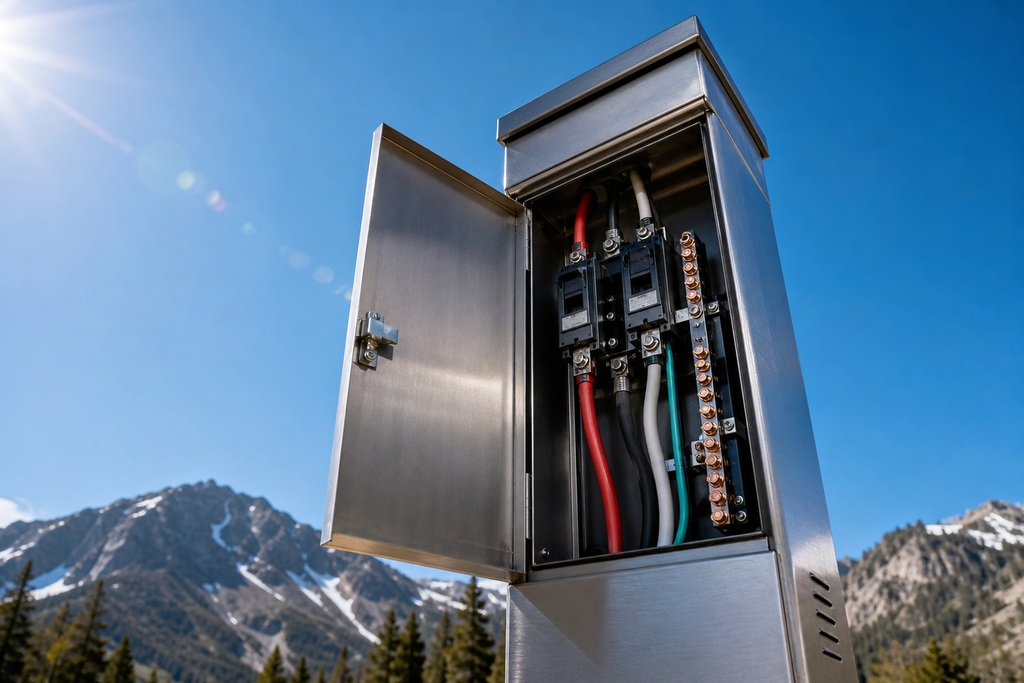
- Power pedestals: weatherproof site units with breakers, surge protection, and sometimes meters. Common brands include Midwest, Milbank, and Eaton.
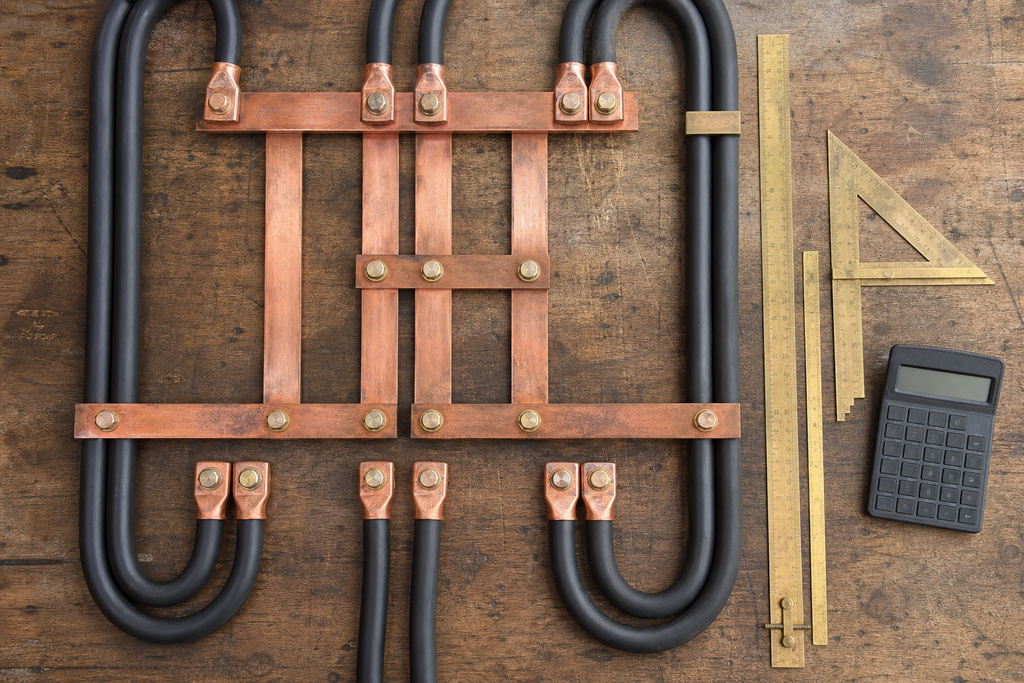
- Distribution panels and subpanels: break the property into loops so a fault or overload is contained, not park-wide.
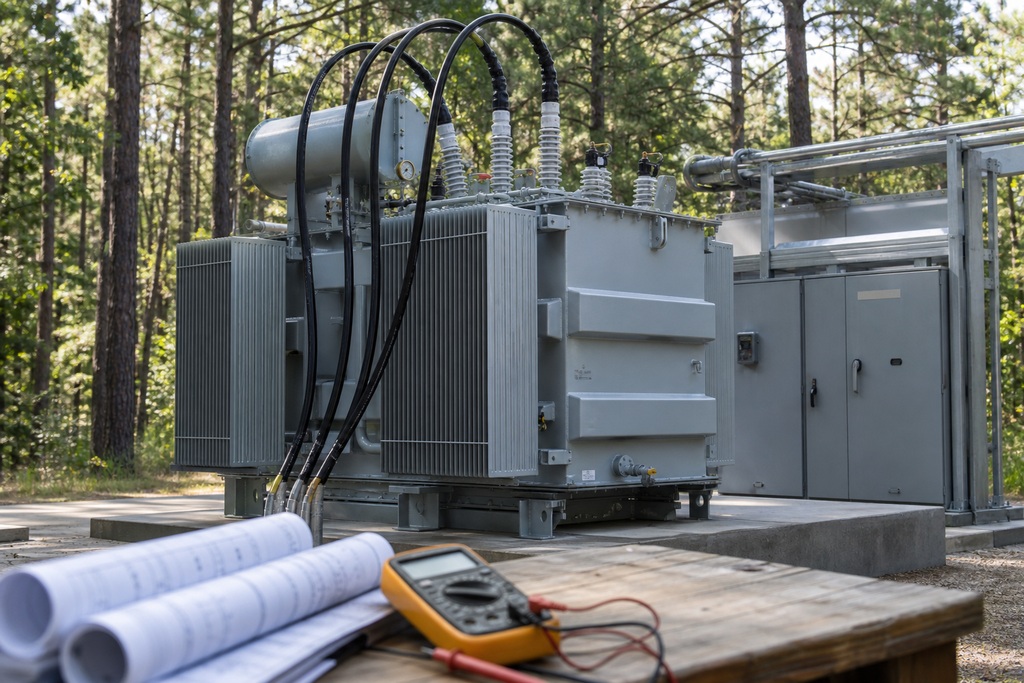
- Pad-mounted transformers: step utility voltage down to service level; a large park may need several.
- Sub-metering: per-site kWh measurement for usage-based billing.
- GFCI protection and grounding: required on many receptacles under recent code, with a dedicated ground rod at each pedestal.
Installation and Per-Site Costs
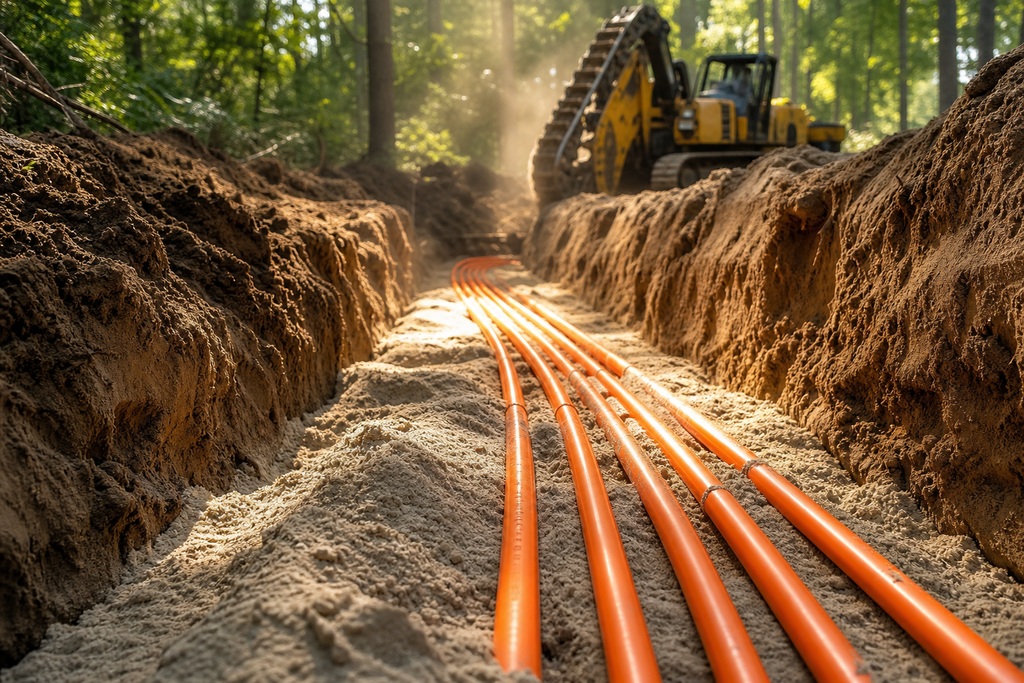
Budget $2,000–$5,000 per site for typical electrical installs, climbing past $10,000 on rock or long runs, on top of a service upgrade that can run from $15,000 to well over $100,000. Trenching is almost always the largest swing, and underground runs cost roughly 20–40% more than overhead: worth it for weather protection, falling-tree safety, and looks.
| Item | Estimated Cost Range |
|---|---|
| Per-site electrical install (trench, conduit, wire, pedestal) | $2,000–$5,000+ (up to $10,000+ on hard terrain) |
| Pedestal equipment only (30/50A) | $300–$800 (full-featured units $500–$2,500) |
| Utility service upgrade / transformer | $15,000–$100,000+ (large parks $20,000–$200,000+) |
| Solar-powered site (array + storage) | $5,000–$25,000 per site |
These figures swing hard on terrain, soil, distance to the power source, and local utility requirements: treat them as planning ranges, not quotes, and confirm current numbers with your utility and contractor. On the return side, electrified sites command 30–100% higher nightly rates than dry sites, and most electrification pays back within 3–7 years depending on local rates and occupancy.
EV Charging Integration
EV charging is a different load from an RV hookup and has to be planned as one: an RV cord is an intermittent household-style draw, while a charging EV is a sustained automotive load that runs for hours. Layering it onto existing pedestals without planning is how you trip park breakers and cook a transformer.
Level 2 charging (240V, 7–19 kW) is the common addition, installed as dedicated EVSE alongside RV pedestals; some parks add DC fast chargers near the entrance. The risk is simultaneity: a big rig running two air conditioners plus an EV pulling 40 amps can exceed the local transformer's limit. The fix is networked load management that throttles EV charging when RV demand peaks, and the 2023 NEC now addresses EV load calculations at RV parks precisely because of this stacking.
Do not let drivers solve it with adapters into 30A or 50A RV outlets. Those circuits were never designed for continuous automotive loads, the overload risk is real, and the liability lands on you. EV charging needs its own equipment and its own load-management scheme: not a dongle.
Off-Grid, Solar, and Microgrid Options
Off-grid solar with battery storage wins where extending utility lines is prohibitively far or environmentally restricted: it's a distance-to-utility economics decision, not a values decision. Solar is not automatically cheaper or greener by default; where a utility line is close, grid extension usually beats a microgrid on both cost and reliability.
Where the grid is genuinely out of reach (deep in a national or state park, or across terrain no utility will trench) a photovoltaic array paired with lithium battery storage can carry lighting, small appliances, and even Level 2 charging, with a propane or diesel generator on standby for long cloudy stretches. Hybrid systems blend all three. At the low end, glamping pods and rustic tent sites often run simple low-voltage solar kits for LED lighting, USB charging, and a mini-fridge, sidestepping any grid connection at all.
Safety, Code, and Permitting
Every powered site lives in a wet, high-traffic environment, so code compliance is non-negotiable and inspected. The core requirements:
- GFCI protection on all 15- and 20-amp receptacles. The 2020 and 2023 NEC expanded GFCI to 30- and 50-amp RV circuits, but many RV electrical systems have normal leakage current that causes nuisance tripping, so industry groups pushed back and several states adopted amendments or delayed enforcement: check what your Authority Having Jurisdiction actually enforces.
- Verified grounding and bonding, with a dedicated grounding electrode (ground rod) at each pedestal in addition to the equipment grounding conductor.
- Wet-location enclosures rated NEMA 3R or 4X, with in-use covers so cords stay plugged in while the cover is closed.
- Permitting and inspection by the local AHJ or state electrical inspector on all work.
The governing documents are NEC Article 551 (RV parks and campgrounds), Article 210 (branch circuits), and NFPA 1194, alongside UL listing for pedestals and outdoor gear.
Pedestal Placement and Site Layout
Place pedestals on the curb/hitch side of the site so power cords never cross the driving lane. Beyond that, three dimensions keep them usable and intact:
- Set the pedestal 3 to 5 feet from the edge of the parking pad: close enough to reach, far enough that a backing rig won't crush it.
- Mount receptacles 36 to 42 inches above ground for easy, dry access.
- Keep cord runs short so campers aren't daisy-chaining extensions across the site.
Billing and Business Models
Flat-rate "free electricity" bundled into the nightly fee works for predictable RV loads, but it breaks the moment EV charging enters. Continuous automotive charging plus commercial utility demand charges, steep monthly fees triggered by peak simultaneous usage, make an all-you-can-use model unsustainable once a few EVs plug in at once.
The alternative is smart pedestals with per-kWh sub-metering, billing campers for exactly what they consume or surcharging EV use. It curbs power abuse, protects your margin against demand charges, and nudges conservation. Capital help exists: the USDA Rural Energy for America Program (REAP) and various state EV grants offset solar, battery, and charging costs, and federal NEVI funds, aimed mainly at highway-corridor fast charging, can flow to destination chargers at parks near major routes.
Who Should Not Electrify Every Site
Not every campground should wire every site to 50 amps, and some shouldn't grid-extend at all. Zoned electrification (premium powered sites plus deliberately rustic, unpowered zones) is a legitimate answer, not a compromise.
Skip full electrification when the terrain, distance, or occupancy doesn't justify it: a handful of remote back-loop sites rarely earn a grid extension that costs six figures. Don't force 50-amp everywhere when your guest mix is tents and small trailers — you'll pay for capacity nobody draws. And don't add EV charging on the assumption drivers will "just use the RV outlet"; that's the overload-and-liability trap, so either commit to real EVSE with load management or don't offer charging yet.
Planning Checklist
Work these steps in order — the early ones protect you from re-trenching later.
- Oversize conduit and service at build time. Pull larger conduit and size the service above today's need so you can add 50-amp and EV capacity without re-digging.
- Get an Article 551 load calc from a licensed electrical engineer before pricing equipment — it sets your transformer and service.
- Bury lines below the frost line and clear of water and sewer runs, per code.
- Specify GFCI and surge protection on the pedestals and confirm your AHJ's GFCI stance.
- Design for zones, premium powered loops and rustic unpowered areas, rather than uniform buildout.
- Evaluate solar + battery only for sites where grid extension is genuinely too far.
- Permit and inspect every phase.
Modern Trends in Campground Electrification
The through-line across every current trend is convergence: the RV cord and the EV plug are no longer separate problems but a single, growing load that the pedestal has to manage in real time. That reframes the pedestal from a passive receptacle into the point where the park's whole power strategy is enforced.
Two forces set the pace. The first is the collision of hungrier rigs and electric vehicles arriving at the same site on the same evening, which makes networked load management the default expectation rather than a premium feature. The second is the shift toward power as a metered, tiered product — parks increasingly treat electricity like Wi-Fi or a premium pull-through, priced and sold rather than bundled and absorbed.
The practical upshot for anyone planning today: build for the load you'll have in five years, not the one you have now, and assume the equipment you install will need to talk to a network. The parks retrofitting fastest are the ones whose original buildout left conduit and service headroom to grow into.
Where the Industry Is Heading
The pedestal is turning into a networked device, and the property is segmenting by power tier. Four shifts are already underway:
- Smart pedestals with WiFi metering, reservation-system tie-ins, and automatic load-shedding.
- Bidirectional power — as Vehicle-to-Load and Vehicle-to-Grid mature, parked EVs could feed peak demand instead of straining it.
- Zoned segmentation into fully electrified premium sites and rustic unpowered zones.
- Modular prefab electrification kits for faster deployment.
Real money is following it. KOA invests tens of millions annually into upgrades weighted toward electrical capacity for 50-amp rigs and EVs; the National Park Service is piloting chargers within park boundaries, including at Redwood National and State Parks; and networks like ChargePoint are partnering with private RV resorts to install smart Level 2 charging that integrates with existing load management.
FAQ
What is the 3-3-3 rule when camping?
The 3-3-3 rule is a consumer trip-planning guideline for RV travelers, not an electrical standard: drive no more than 300 miles a day, arrive by 3 p.m., and stay at least 3 nights. It has nothing to do with campground power infrastructure — it's about pacing a road trip and avoiding fatigue.
How to get electricity at a campsite?
For an operator, you bring in utility service (or a solar microgrid), install a transformer and distribution panels sized under NEC Article 551 demand factors, trench conduit to each loop, and mount weatherproof pedestals with 30- and 50-amp receptacles. For a camper, you simply reserve a site marked with electric hookups and plug your rig's cord into the matching outlet on the pedestal.
What is the 200 rule for camping?
The 200 rule is a Leave No Trace camping convention: set your tent, campfire, and washing or waste activities at least 200 feet from lakes, rivers, and streams to protect water quality. It's an environmental practice for campers and has no bearing on electrical infrastructure planning.
What is the 444 rule for camping?
The 444 rule is another RV travel-pacing guideline: drive no more than 400 miles per day, stop by 4 p.m., and stay 4 nights — a slower cousin of the 3-3-3 rule. Like the others, it's about trip comfort, not campground electrification.
References
- National Fire Protection Association — NEC Article 551, Recreational Vehicles and Recreational Vehicle Parks and Article 210, Branch Circuits (2020 and 2023 cycles)
- National Fire Protection Association — NFPA 1194, Standard for Recreational Vehicle Parks and Campgrounds
- USDA — Rural Energy for America Program (REAP)
- U.S. Department of Transportation — National Electric Vehicle Infrastructure (NEVI) Program
- National Park Service — EV charging pilot guidance, Redwood National and State Parks
- Manufacturer spec sheets: Midwest, Milbank, and Eaton RV power pedestals